
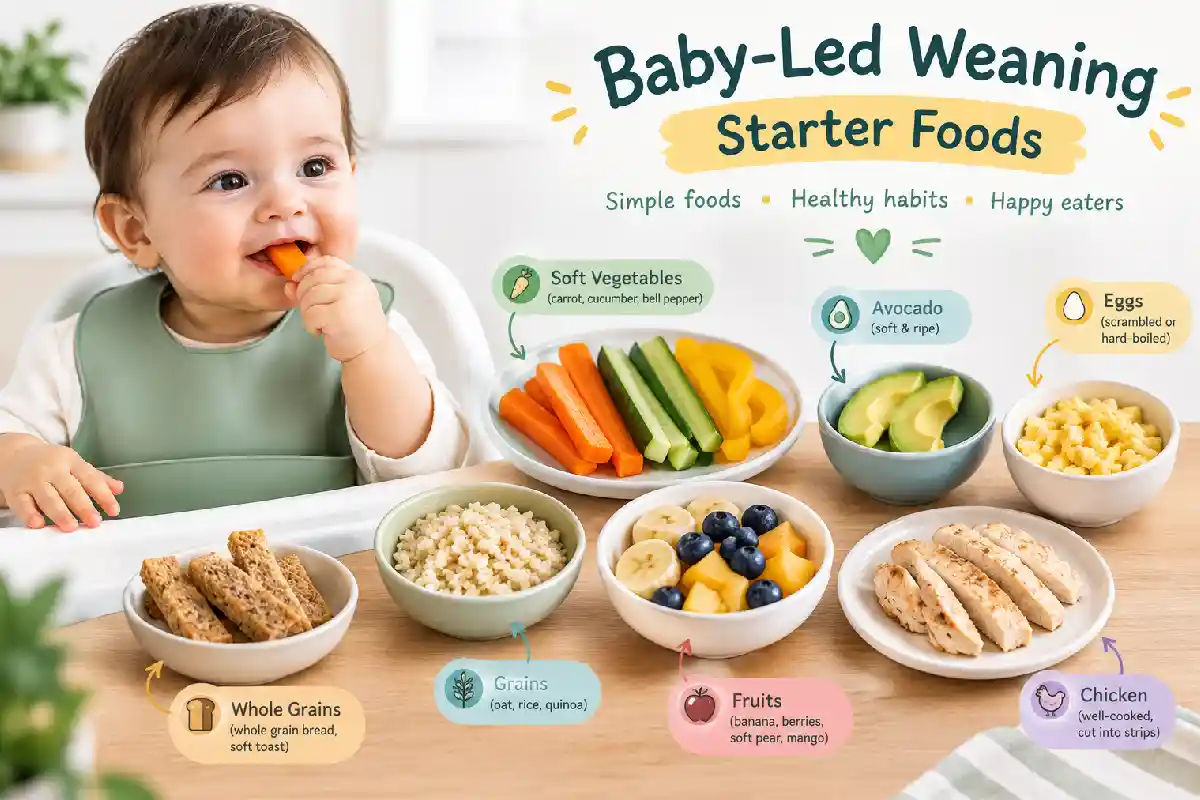
Introducing your baby to solid food without any doubt is an important step, but it may be somewhat frightening too. When considering baby-led weaning for the first time, the most frequently asked question is quite simple – what should I feed my baby?
But you should not create something unique and cook a lot of different baby foods. As soon as your child is ready for complementary feeding, you can provide them with plenty of various soft foods.
According to the latest recommendations by the CDC and AAP, the introduction of foods besides breast milk or infant formula should be started when a baby reaches the age of 6 months, provided that they are developmentally ready for this.
Therefore, baby-led weaning can imply that you can offer some finger foods and let your kids participate in eating with the whole family, not just use a spoon-feeding technique. Moreover, a lot of people tend to combine both.
When Is Your Baby Ready for Baby-Led Weaning?
Most babies will be able to take in complementary foods by the age of 6 months; however, age is not everything.
Some signs that your baby is ready for complementary foods include:
- Capable of sitting up straight with minimal support
- Controlled neck and head movements
- Being able to grab objects and bring them closer to mouth
- Interest in food
- Able to swallow and not push the food back with their tongues
- Hand-mouth-eye coordination in eating the food
According to the CDC, your baby should not consume solid foods before 4 months, but 6 months is the best time to start complementary foods.
What are the Best Baby-Led Weaning Starter Foods?
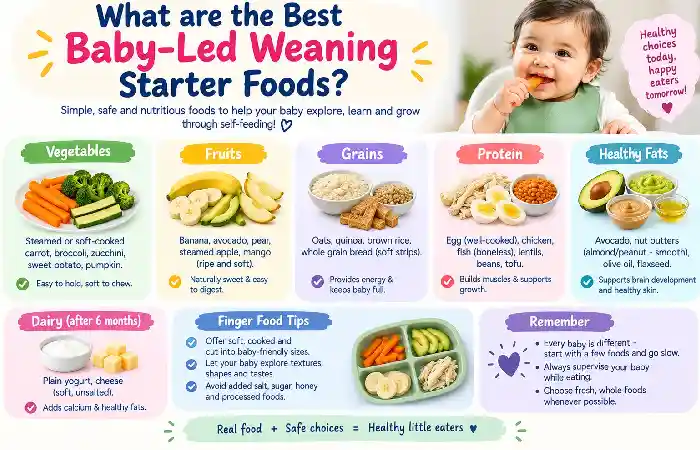
The best starter foods should be soft and easy for the baby to grab.
There is no particular order that you need to introduce your baby to foods; however, the CDC has suggested foods belonging to various food groups like vegetables, fruits, protein foods, dairy foods without sugar, and whole grains.
Below are some starter foods that you can try for your baby.
1. Soft Cooked Sweet Potatoes
Some of the best finger foods for babies include sweet potatoes owing to the reason that sweet potatoes cook to become very soft.
They can be sliced into larger sticks and wedges so that they can easily be held by the babies. Bake, steam, or roast the sweet potatoes until they are very soft so that they can be mashed using fingers.
Furthermore, sweet potatoes are very rich in carbohydrates and nutritional value.
2. Ripe Banana
Bananas are very easy to prepare.
They only require a ripe banana cut into appropriate sizes. Because bananas are very soft, this helps babies easily manipulate the food in their mouths.
Bananas can also be prepared together with other types of foods, including full-fat yogurt and oatmeal.
3. Avocado
Another easy finger food for babies is avocado.
They have a very soft texture and can be easily mashed. Furthermore, they can be served in slices and strips that babies can easily hold.
Furthermore, they contain fat and calories.
4. Steamed Broccoli
Once they are cooked properly, broccoli florets prove to be good finger foods.
Keep enough of the stem for your baby to grip, but at the same time ensure that the vegetable is soft.
There are various vegetables which the NHS suggests you give to your baby from 6 months of age, like broccoli, carrots, peas, spinach, peppers, cauliflower and many more.
5. Soft Cooked Carrots
A raw carrot could be difficult for your baby to digest; therefore, proper preparation is essential.
Boil or steam your carrot sticks till they are extremely soft, mashable, and cut into proper pieces, not hard lumps.
6. Soft Pear
Your pear should be ripe and soft.
In case your pear is still firm, cook your pear, soften it, remove the seeds and any other hard lumps, then cut it into proper pieces.
Cooking becomes necessary in order to make fruits like pear and apple soft for your baby.
7. Soft-Cooked Apple
An apple is another excellent starter food, but a raw apple could be a choking hazard for your baby.
Hence, it is advisable to cook it before making it soft.
8. Scrambled Egg
Eggs provide nutritious protein-based food that can be introduced alongside the introduction of complementary foods.
Ensure that eggs are well-cooked and served in a form that will be easy for your child to eat.
The egg is also one of the most common allergenic foods that can be introduced alongside complementary foods.
In case of having severe eczema or an egg allergy in your baby, consult with the health care provider to discuss the introduction of peanut-containing foods and other allergens.
9. Plain Whole Fat Yogurt
Plain yogurt without any added sugars can be introduced as a simple food in your baby’s diet.
Yogurt can either be served in a preloaded spoon or mixed with mashed fruits like banana or pear.
Dairy foods like plain yogurt and pasteurized cheese can be included in complementary foods, while cow’s milk cannot be used as the primary milk source until 12 months.
10. Soft Toast Strips
Toast gives your baby an opportunity to try something new in terms of texture.
Bread can be made into strips, and the pieces will be easy to grasp. Avoid adding any sweet spread on them; however, you can put appropriate toppings such as peanut butter on them.
However, use peanut butter very sparingly on toast. Do not add big spoonfuls, as it can be a choking hazard for infants.
11. Soft Pasta
Soft pasta can be used as finger food for your child.
Choose an appropriate type of pasta and cook it properly. Add vegetable puree or sauce to it without sugar.
12. Soft Beans and Lentils
Such foods give necessary protein and other nutrients to your baby.
Soft beans and lentils can be mashed with other food or offered in small pieces. Beans, lentils, and peas are protein foods for babies.
13. Shredded or Soft-Cooked Meat
The intake of meat helps to ensure that there will be an intake of protein and iron, which are crucial at this stage.
Choose soft meat, cook it well, clean out any bones or tough parts, and prepare it to the desired consistency for your baby.
According to the CDC, babies between the ages of 6 and 12 months must eat soft and small pieces of meat or fish with no bones.
14. Soft Fish
When soft and boneless fish is thoroughly cooked, it may also be included in a diversified diet.
Be careful about the presence of bones in fish and choose an appropriate type.
Fish is one of the most common allergens; therefore, introduce it carefully.
15. Tofu
This is another great example of plant-based protein that is easy to digest.
It can be cut up into proper pieces or crushed and included in another soft food. It may also be included in cooked vegetables.
Tofu and soy products are good sources of protein.
Foods to Avoid During Baby-Led Weaning
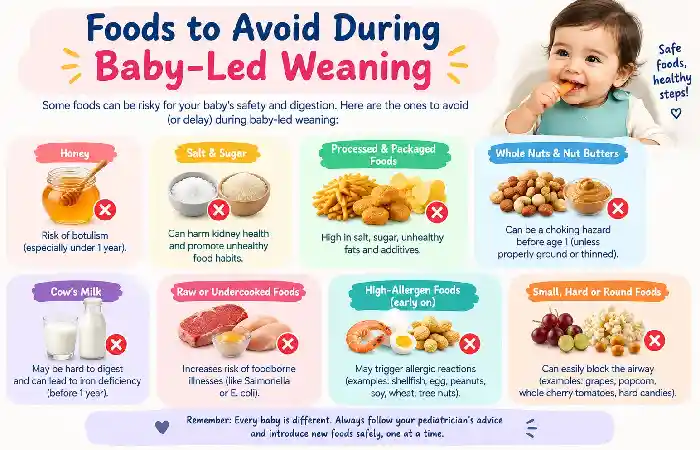
Certain foods are unsuitable or require specific preparation.
Honey Before 12 Months
Avoid giving your baby honey before they reach the age of 12 months because of infant botulism.
Whole Nuts
Nuts can be a hazard due to choking and should not be given to babies as whole foods.
Nut-containing foods can be given as appropriate food forms, such as thin nut butter that is spread onto the food.
Added Salt
There is no need for added salt in babies’ food. Avoid very salty foods and stock cubes.
Added Sugar
It is unnecessary to add any sugar to foods for babies. You will help babies develop the taste of different foods by choosing nutritionally rich foods.
Hard and Round Foods
Whole grapes, popcorn, hard raw vegetables, and other similar foods can create choking hazards if prepared improperly.
What About Allergens?
Some foods containing common allergens can be given to babies together with complementary foods and not delayed unnecessarily.
These foods include:
- Egg
- Peanut
- Fish
- Wheat
- Dairy
- Sesame
- Soy
- Shellfish
According to the CDC, you should introduce potentially allergenic foods along with other complementary foods.
A Simple First-Week Baby-Led Weaning Idea
You don’t need to follow a strict menu, but having a basic plan can make the first week easier.
| Day | Foods to explore |
| Day 1 | Avocado + soft sweet potato |
| Day 2 | Banana + plain yogurt |
| Day 3 | Soft broccoli + scrambled egg |
| Day 4 | Cooked pear + soft toast |
| Day 5 | Sweet potato + soft lentils |
| Day 6 | Soft pasta + vegetables |
| Day 7 | Avocado + well-cooked egg |
Tips for Making Baby-Led Weaning Easier
Baby-led weaning does not have to be perfect.
There are some ways through which weaning can be made easier:
Eat together whenever possible: Babies learn by watching others eat.
Keep the portions small: You can give them more when necessary.
Prepare for messes: Exploration is the way infants learn about food.
Vary your menu: Always introduce your baby to a variety of foods like vegetables, fruits, cereals, and proteins.
Never force-feed your baby: Let them explore the food by themselves.
Practice repetition: An infant might need many opportunities before getting used to new tastes or textures. According to the NHS, sometimes an infant needs 10 or more times before accepting the new food.
Final Thoughts
Selecting food items as the initial step of baby-led weaning should not pose any problem. Choose healthy food items which the child would easily consume and introduce more food items as she grows up.
Avocado, banana, sweet potatoes, broccoli, cooked fruits, eggs, yogurt, lentils, tofu, pasta, and appropriately prepared meat and fish can all become a part of your baby’s complementary feeding plan.
The only important point to keep in mind here is the preparation of food in a way that makes it safe for your baby. Feed your baby in an upright posture, keep observing her during meals, and avoid offering those food items which have the potential to choke her.
