
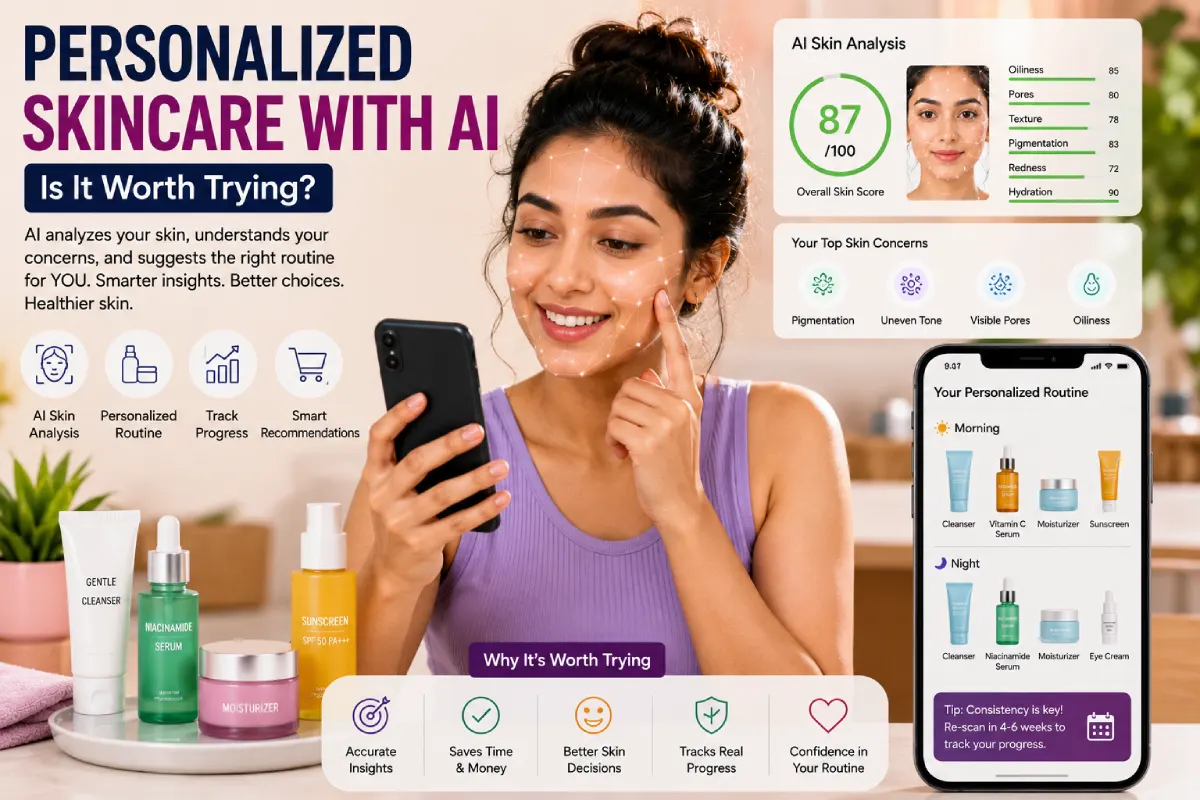
For years, skincare felt like a guessing game. You bought a serum because it was popular. You followed a routine you saw online. Sometimes your skin improved. Many times it stayed the same or became more irritated. The problem was simple: most advice was made for “average” skin, not for your specific face, climate, and concerns.
In 2026, artificial intelligence is trying to change this. AI-powered tools now offer personalised skincare — analysis of your skin followed by custom product suggestions or routines. The big question many people ask is: is it actually worth trying?
This article looks at how personalised AI skincare works, what it can do well, where it falls short, and whether it makes sense for most people, especially those with Indian skin.
What Personalised Skincare with AI Really Means
Personalised AI skincare usually follows these steps:
- You take a clear photo of your face or answer a few questions.
- AI analyses visible features such as oiliness, pores, dark spots, redness, texture, and fine lines.
- The system combines this with your age, climate, lifestyle answers, or past preferences.
- It creates a short routine or recommends specific products that match your results.
Some tools stop at analysis and general advice. Others link directly to products you can buy. A few platforms even offer custom-formulated products, though these are still less common and often more expensive.
How AI Personalisation is Different from Old Advice
| Old Way | AI Personalised Way |
|---|---|
| Same routine for many people | Suggestions based on your face scan |
| Trial and error | Data-based starting point |
| General “for oily skin” labels | More specific concerns (pigmentation + oil) |
| Hard to track progress | Regular scans can show changes |
| Advice from ads or friends | Algorithm trained on many skin examples |
The main improvement is that the advice starts from your actual skin instead of a broad category.
What AI Personalised Skincare Does Well
Gives a clearer starting point
Many people do not know if their skin is oily, dry, combination, or dehydrated. AI analysis is usually better than pure self-guessing.
Helps with common Indian skin concerns
Pigmentation, uneven tone, oiliness in humidity, and barrier issues from hard water or pollution are frequent. Good tools are improving at recognising these patterns.
Reduces random product buying
Instead of adding five new serums at once, you get a shorter, more focused list. This can save money and reduce irritation from over-layering.
Tracks changes over time
If you scan every few weeks under similar conditions, you can see whether a routine is helping. This feedback is useful and hard to get otherwise.
Convenient
You can do it at home in a few minutes. No need to visit a clinic for basic guidance.
Where AI Personalisation Still Falls Short
It is not a doctor
AI cannot diagnose medical conditions such as eczema, severe acne, infections, or hormonal issues. Persistent problems still need a real dermatologist.
Photo quality matters a lot
Poor lighting, makeup, or filters can give wrong readings. Natural daylight is best.
Commercial influence
Many tools are linked to brands or shopping platforms. The analysis may be decent, but the product list often favours what they sell.
Not fully custom for everyone
True custom formulation (made only for you) is still limited and expensive. Most “personalised” routines use existing products matched to your profile.
Results vary by tool
Some apps are better trained on diverse skin tones and climates. Others still perform unevenly.
Is It Worth Trying? A Practical View
For most people, the answer is yes — with realistic expectations.
It is worth trying if:
- You feel confused by too many products
- You want a better starting point than random advice
- You like tracking progress
- You shop online and want more confidence
- You have common concerns like pigmentation, oiliness, or dryness
It may feel less useful if:
- You already have a simple routine that works well
- You expect medical-level diagnosis
- You dislike uploading face photos for privacy reasons
- You want completely custom-made products on a budget
The best approach is to treat AI as a helpful assistant, not as the final expert.
How to Try Personalised AI Skincare Smartly
- Start with a free or low-cost analysis tool.
- Use a clean face and natural daylight for the photo.
- Read the full report, not only the product suggestions.
- Choose only one or two new products at a time.
- Give any new routine at least 4–6 weeks before judging.
- Scan again after some weeks to check progress.
- Keep basic habits strong: gentle cleansing, moisturising, and daily sunscreen.
Comparison: Generic Routine vs AI Personalised Approach
| Aspect | Generic Routine | AI Personalised Approach |
|---|---|---|
| Starting point | Broad skin type | Your face scan + concerns |
| Product number | Often too many | Usually shorter list |
| Suitability | Hit or miss | Higher chance of better match |
| Progress tracking | Hard | Easier with regular scans |
| Cost risk | Higher chance of unused products | Lower if you follow selectively |
| Need for doctor | Still needed for serious issues | Still needed for serious issues |
Special Notes for Indian Skin
Indian skin often deals with:
- Higher melanin and pigmentation risk
- Combination patterns (oily T-zone, drier cheeks)
- Effects of humidity, pollution, and hard water
- Strong sun exposure
Newer AI tools are getting better at these factors. Some platforms specifically mention training on Indian skin tones and local climate. This makes the suggestions more relevant than older global tools that were trained mainly on lighter skin.
Still, no app understands your full life — stress, sleep, diet, and hormones also affect skin. AI is only one part of the picture.
Realistic Benefits You Can Expect
- Less confusion when choosing products
- Better awareness of your actual skin pattern
- Fewer impulse purchases
- Clearer idea of what is improving over time
- More confidence when shopping online
You should not expect dramatic overnight changes or a perfect custom formula for a low price. Consistent basic care still matters more than any algorithm.
Common Mistakes to Avoid
- Believing every product suggestion without checking ingredients
- Changing the entire routine at once
- Scanning in bad lighting and trusting the result
- Ignoring how your skin actually feels
- Using AI as a substitute for medical help when needed
Final Balanced Opinion
Personalised skincare with AI is worth trying for most people who feel lost in the skincare market. It reduces pure guesswork and gives a more informed starting point. The technology has improved enough in 2026 to be useful for everyday cosmetic concerns, especially when used carefully.
It is not magic and it is not a replacement for professional medical advice. The real value comes when you combine AI insights with simple, consistent habits and common sense.
If you are curious, start small. Do one analysis, follow the basic suggestions selectively, and observe your skin for a few weeks. You will quickly see whether it adds value for you. For many people, moving from random product buying to data-supported choices is a clear improvement.
