

Osman Basaad
Digital Marketing & Technology Writer
Inzemam Ul Haq
SEO & Digital Marketing ProfessionalLast Updated: November 9, 2026
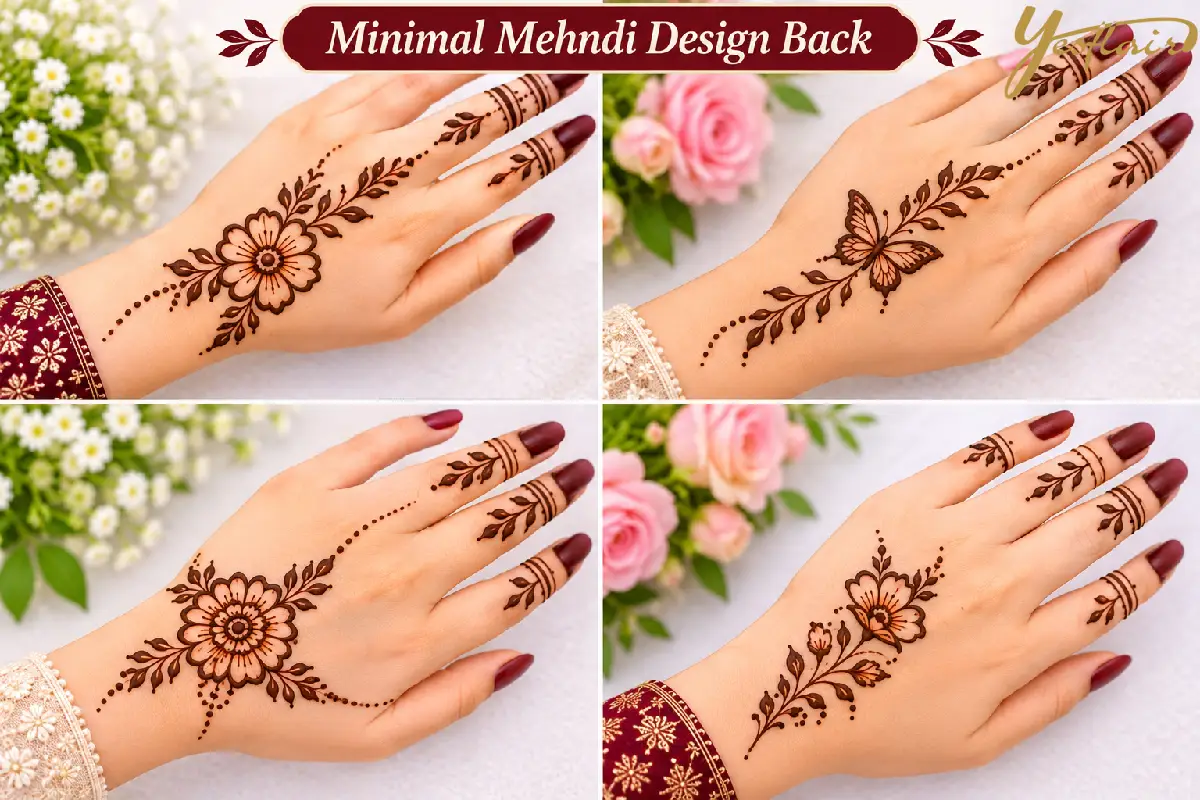
Mehndi is an essential and gorgeous aspect of traditional celebrations; however, a complete hand design isn’t always necessary to enhance the beauty of your hands. Traces of miniature flowers, light leaves, intricate lines, and small geometric figures can be used to give a pretty look without covering the entire hand. That’s the explanation behind the rising popularity of the minimal mehndi design back.
A backhand is a prominent area of the hand and is usually visible when you hold your phone, wear any jewellery, wish someone, take pictures. So, with the right amount of least pattern design, you can enhance the natural shape of your wrist and fingers with a pretty accent.
A wedding, festival, family gathering, college function, trip or simple street – if you have to put mehndi, then there are loads of simple patterns that you can do. Starting from a little flower to a nice Arabic trail, the designs are easy to do and you can also play with the motifs as per your liking. Check out some pretty mehndi designs, tips to apply and tips to make it look neat and elegant.
Why Choose a Minimal Mehndi Design for the Back Hand?
Very simple mehndi designs are characterized by precise spacing and detailing. Instead of covering the entire hand, they may target some areas like the wrist, fingers, centre of hand, or knuckles.
They are also highly flexible. A tiny floral arrangement will go nicely with a classic outfit, although a pattern that is geometric will look fantastic with a contemporary dress too. Use a subtle design, add in with rings or bangles, or bracelet to match your clothes.
Some reasons to go for the minimal pattern:
- Fast to apply: Simple designs typically take less time to apply than complex, full-hand patterns.
- Easy to learn: simple flowers, dots, leaves and lines are much easier to practice.
- Large scale: Spacious openings give this design an airy feel rather than a cluttered look.
- Multiple looks: Simple patterned dresses are preferred for normal day-to-day outings, festivals, house parties, as well as marriage functions.
- You can include initials, tiny designs, or other personal information.
- The pattern of bracelets and rings can make it look like it’s wearing very fragile hand jewellery.
The wonder of minimal mehndi is its density. A couple of elements strategically added help to keep the back of the hand elegant without having to go to town with the artistry.
10 Beautiful Minimal Mehndi Design Back Ideas
If you need ideas, here are some designs that combine contemporary styling with traditional patterns. Use a particular design for one of your occasions, the time you have and the kind of detailing you like.
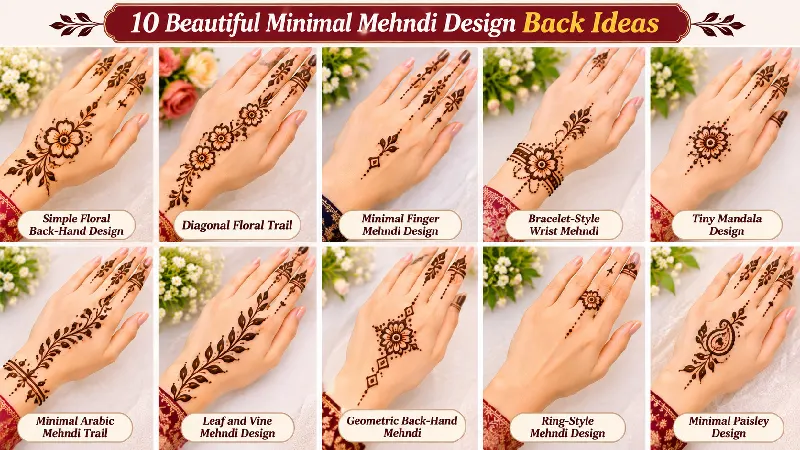
1. Simple Floral Back-Hand Design
The most effortless way to get a delicate appearance is by taking a tiny blossom at the focal point of the back hand. There are four, five, or six cuts all around – with a little line or even a round detail at the centre.
Overlay the flower with two or three little leaves to make a more balanced pattern. Leave the part of the skin that surrounds the flower empty if you want to keep it simple.
This design is suitable for those who are new to jewelry-making, for casual get-togethers, as well as small family celebrations. Moreover, it looks fantastic with fine rings.
2. Diagonal Floral Trail
A diagonal floral trail. Begins on the wrist and carries towards the index or middle finger. Has small flowers, swirly stems and leaves, and sporadic dots.
It also forms a flow throughout the hand with a symmetrical pattern to the design. It is good to leave some sections open and free to breathing room, as you do not need to have everything filled in.
Diagonal trail makes a good choice for ganesh chaturthi, engagement and other parties. One can modify this pattern by making small paisleys and additional leaves for a richer look.
3. Minimal Finger Mehndi Design
If you like a very delicate style, finger mehndi is perfect. Rather than covering the entire back hand, a few patterns are applied to one or two fingers.
Play with fine horizontal lines, very small flowers, chains of leaves, dots or designs which look like rings! A small design around your middle or index finger adds a lot of style while not taking a lot of time!
For a look that’s well-coordinated, do the same pattern on two fingers, leaving the rest of the fingers plain. Great for college weekends, drinks at the office, or just hanging out.
4. Bracelet-Style Wrist Mehndi
The bracelet style adorns the wrist with a pattern similar to a fine chain or bracelet. It can include small flowers, linked dots, curving lines, leaves, and/or a central ornamental design.
For maximum simplicity keep the band as narrow as possible and include delicate detailing. Alternatively, include a small drop or flower hanging from the centre of the bracelet.
This pattern has a beautiful appeal when you wear traditional dresses, sarees, kurtis or any kind of festive dress. It is equally good for a person who likes jewellery inspired mehndi with no thick coverage on hands.
5. Tiny Mandala Design
The mandala mehndi has its own symmetrically circular shape and average shape. To take it for a minimal one, make the circles small in the centre of the back hand and add dots, leaves, and curved borders.
You may also want to draw many layers within the design instead of trying to add complex fill-ins. A small mandala can also be linked back to the wrist with a delicate line or small trail of flowers.
This pattern is appropriate for festivals, pooja ceremonies, family functions and more for when you are looking for a traditional design with a contemporary appeal.
6. Minimal Arabic Mehndi Trail
The popular style of writing in mehndi is Arabic, with its sweeping lines, bold outlines of floral forms and open background. The design of Arabic with light, less concentrate patterns.
Begin with a curved or slanting stem, then draw some flowers, leaves and dots. To make one flower bigger to work as a focal point, keep everything else quite simple.
Look great on the back hand as it flow with the natural direction of fingers and wrist. This tattoo design is perfect when you are looking for something traditional with minor detailing.
7. Leaf and Vine Mehndi Design
These are classic patterns. A tiny vine can start around the wrist and extend toward one finger, with curved stems and tiny leaves.
Alternatively, you can create small buds or dots between the leaves. Or, you might draw a small vine down the side of the hand, while leaving the centre empty.
This is arguably the most flexible back me would design as it can be made shorter, longer or more elaborately decorated to as many or few as you wish. Ideal for a day-time event and simple festive appearance.
8. Geometric Back-Hand Mehndi
This design is perfect if you like modern motifs. It makes use of diamonds, triangles, circles, parallel lines, and tiny squares.
In the centre of the hand, a basic diamond shape pattern can be encircled with neat little dots, or short lines. Alternatively, make a tiny geometric band across one finger.
Maintain evenly spaced outlines and use minimal details. The design is clean, minimalistic and modern and can go well with either western or ethnic dresses.
9. Ring-Style Mehndi Design
The henna designs will look like band or ring patterns around the finger. Draw a circular design, small flower or band on the fingers followed by some tiny thin lines connecting to the hand.
For a very delicate appearance, decorate only one finger and stop a few dots along the connecting line. Or use two ring motifs with a little flower in the middle.
The type of design to wear for those who love fancy detail and want most of the hand to be exposed.
10. Minimal Paisley Design
Paisley is an integral part of traditional mehndi art. Using a small paisley in the middle of your hand or anywhere along the side of your hand will result in a stunning pattern without having to fill your hand.
Inside the Paisley, add a few curved lines, dots or tiny leaves. To make it symmetrical, stick a small flower right next to it.
This pattern is for weddings, festivals, Eid and family functions. This adds a traditional touch to a minimum and modern theme of mehndi.
How to Choose the Right Minimal Mehndi Design for Different Occasions
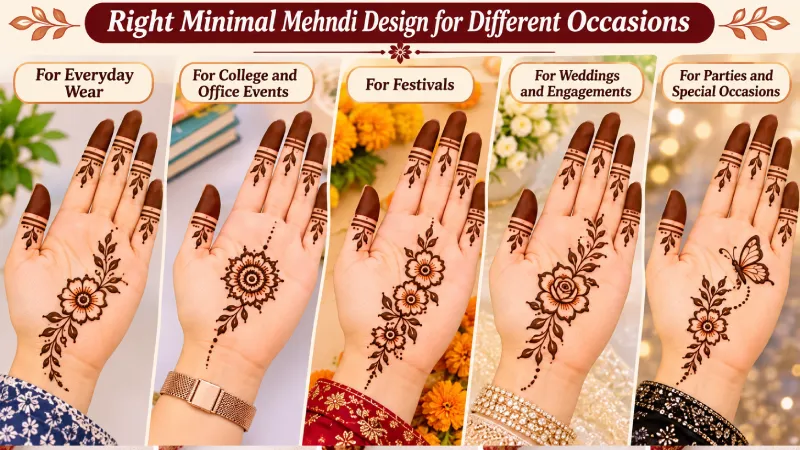
If you choose a design for wearing somewhere at work, then it is quite enough to wear it at a wedding party, but if a bridal style, then it is better not to choose it for casual outing.
For Everyday Wear
Opt for small blooms, short veins, small finger lines and a basic wrist band. These designs look neat and are not complicated to detail.
For College and Office Events
Finger mehndi, geometrical designs, and tiny floral motifs will do. If you are opting for a more understated look, use a light pattern that is limited to a part of the hand.
For Festivals
With Diwali, Eid, Teej, Karwa Chauth, and all other festivals give a shot to a design like Arabic trails, mandalas, paisleys, floral bracelets, whatever suits your mood. Make it a bit more elaborate by adding few more adornments.
For Weddings and Engagements
Few mehndi looks can be as dazzling at the wedding functions with you can have a well-groomed look with lesser mehndi. Think of a more intricate floral trail on the hand, a pretty designed pattern around the wrist, or a combination of mandala or finger patterns.
For Parties and Special Occasions
Minimal rose, geometrical motif, or jewellery-inspired pattern can help match party wear. Coordinate the design with the design of your rings and bracelets as well as nail colour to achieve elegant appearance.
Tips for Applying a Neat Minimal Mehndi Design
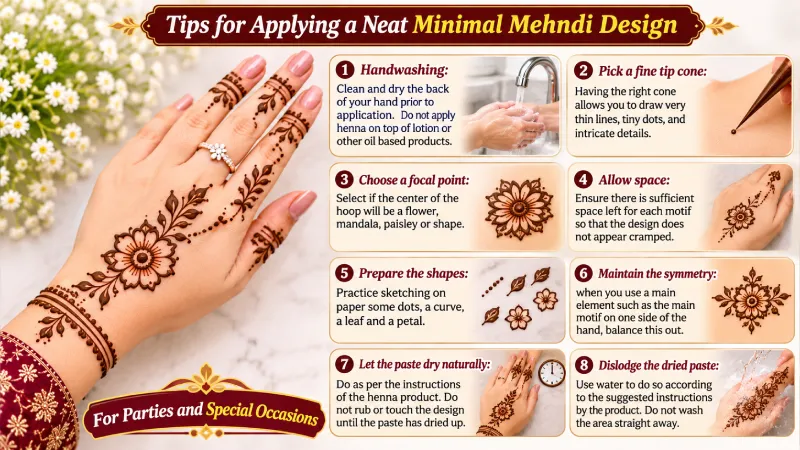
While the motifs are minimal, simple execution is key. With less elements on the item, a slight uneven line or positioning of the motif can stand out more.
Follow these tips for a better result:
- Handwashing: Clean and dry the back of your hand prior to application. Do not apply henna on top of lotion or other oil based products.
- Pick a fine tip cone: Having the right cone allows you to draw very thin lines, tiny dots, and intricate details.
- Choose a focal point: Select if the center of the hoop will be a flower, mandala, paisley or shape.
- Allow space: Ensure there is sufficient space left for each motif so that the design does not appear cramped.
- Prepare the shapes: Practice sketching on paper some dots, a curve, a leaf and a petal.
- Maintain the symmetry: when you use a main element such as the main motif on one side of the hand, balance this out with a small element on the other.
- Let the paste dry naturally: Do as per the instructions of the henna product. Do not rub or touch the design until the paste has dried up.
- Dislodge the dried paste: Use water to do so according to the suggested instructions by the product. Do not wash the area straight away if instructed not to water it.
Tips for Applying a Neat Minimal Mehndi Design Front are also same.
Don’t forget that a simple design does not have to be asymmetrical. A floral design that has a natural flow can be simply stunning when filled in.
How to Make Your Mehndi Stain Look Better
As for all art forms, the aesthetic qualities of a mehndi can be subjectively perceived. The final colour will differ from person to person and will depend on henna quality, skin type, method of application, and after-care. To obtain more pleasing results, use fresh, high-quality henna paste and apply it with care.
Here are some practical suggestions:
- Apply a quality product designed for on skin use.
- Ensure you follow the suggested application and time.
- Don’t scratch, vigorously scrub, or even rub the design.
- Follow the manufacturer’s aftercare instructions.
- Do not scrub the stain, just let it develop naturally.
With natural henna, from orange the hue is deepened to a rich reddish-brown. How much change occurs depends on each individual so don’t assume each design will turn out the same.
A word of caution: Never use products labeled as black henna, particularly if the ingredients are unknown. Some black henna products contain para-phenylenediamine, which can lead to serious skin reactions. Be sure to use a skin-safe henna product from a reputable source, read the ingredients, and visit a doctor if you develop burning, swelling, blistering, or a large rash.
Frequently Asked Questions
1. What is the simplest mehndi design?
A small floral design, delicate leaf trail, tiny mandala, or finger design would be a good place to start. These are all easy shapes and do not have to fill the entire hand.
2. How long does a minimal back-hand mehndi design take?
A very tiny pattern might be just a few minutes, but any floral trail or bracelet pattern could take longer.
3. Can I wear minimal mehndi for a wedding?
Yes. You can opt for a intricate Arabic trail, flower bracelet, mandala or a finger design. Light mehndi is the best option for light wedding functions if you don’t want any flamboyance.
4. What design looks good on the back of the hand?
Flowered trails, Arabic designs, finger motifs, and designs that resemble a bracelet are the rage. The ideal one among them should be decided based on your hand shape, outfit, and style.
5. Can I wear a light mehndi everyday?
Yes. Smaller flowers, dots, leaf patterns, and simple finger designs work well for daily wear because they’re less prominent and usually take less time to create.
6. How do I improve a simple mehndi design?
Keep the lines clean, spacing even, and put a stand-out point in the centre. You can introduce little dots, a few leaves, or a small geometric shape without making the pattern busy..
Final Thoughts
You don’t need a full mehndi to look classy. Just a few tiny flowers, graceful vines, finger patterns, mandalas and bracelet-like detailing with minimal work make a pretty mehndi look. A perfect minimal mehndi design back can blend seamlessly with your casual or daily wear as much as your festival and wedding attire.
Select a design that suits your personal style, ensure that each part is smooth and slick and leave sufficient scope for individual characteristics. If a tiny flower motif and flowing Arabic trail are what you prefer, then you can never go wrong with minimal mehndi while exploring all its possibilities of finding a modern twist to traditional henna art.
