
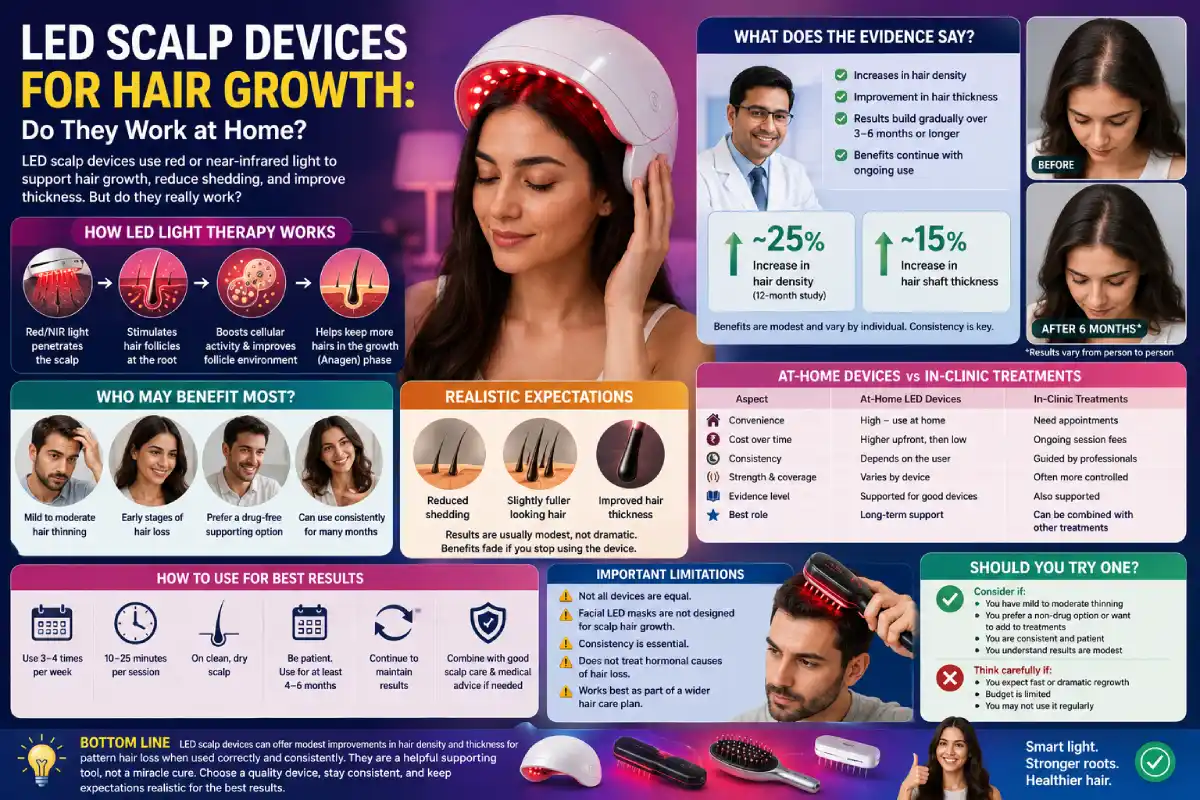
LED Scalp Devices for Hair Growth: Do They Work at Home?
Hair thinning and hair fall make many people look for new solutions. In recent years, LED scalp devices and red light therapy helmets or caps have become popular for home use. These devices shine red or near-infrared light on the scalp and claim to support hair growth, reduce shedding, and improve thickness.
The big question is simple: do they actually work when used at home?
This article explains how these devices are supposed to work, what the evidence shows, who may benefit, and what realistic results look like.
How LED Scalp Devices Are Supposed to Work
These devices use low-level light therapy (also called LLLT or photobiomodulation). Most use red light in the range of about 630–680 nanometres. Some also include near-infrared light.
The light is thought to:
- Reach the hair follicles
- Support cell activity in the follicles
- Improve the environment around the follicles
- Help keep more hairs in the growing phase for longer
It is a non-invasive, drug-free approach. You wear a cap, helmet, or use a comb-style device for a set time several times per week.
What Does the Evidence Say?
Research on low-level light therapy for pattern hair loss (androgenetic alopecia) shows modest but real benefits for some people.
Studies have found:
- Increases in hair density (number of hairs in a given area)
- Some improvement in hair thickness
- Results that build gradually over several months
- Benefits that continue with ongoing use
One longer study lasting 12 months showed about a 25% increase in hair density and around 15% increase in hair shaft thickness with consistent use. Other trials have reported noticeable improvements compared with sham (fake) devices.
Important points from the research:
- Results are usually modest, not dramatic
- Benefits appear after consistent use for 3–6 months or longer
- The effect is generally smaller than what is seen with proven medications like minoxidil or finasteride
- Devices need to deliver the right wavelength and enough light energy
- Not every glowing red device is equally effective
Who May Benefit Most
LED scalp devices tend to help more in these cases:
- Mild to moderate pattern hair thinning
- Early stages of hair loss
- People looking for a drug-free supporting option
- Those who can use the device consistently for many months
They are less likely to help significantly when:
- Hair loss is advanced and many follicles are no longer active
- The cause is scarring alopecia or certain medical conditions
- Use is irregular
Realistic Expectations
Most people who respond well notice:
- Reduced shedding after some weeks or months
- Slightly fuller-looking hair over time
- Improvement in hair thickness in treated areas
Very few people experience thick, dramatic regrowth that completely reverses advanced thinning. Results vary from person to person. When you stop using the device, the benefits usually fade over time.
Home Devices vs Professional Treatments
| Aspect | At-Home LED Devices | In-Clinic Treatments |
|---|---|---|
| Convenience | High – use at home | Need appointments |
| Cost over time | Higher upfront, then low | Ongoing session fees |
| Consistency | Depends on the user | Guided by professionals |
| Strength & coverage | Varies by device | Often more controlled |
| Evidence level | Supported for good devices | Also supported |
| Best role | Long-term support | Can be combined with other treatments |
Important Limitations
- Not all devices are equal. Some consumer products use weak light or poor coverage.
- Facial LED masks are usually not designed or proven for scalp hair growth.
- Consistency is essential. Skipping sessions reduces the chance of results.
- These devices do not treat the root hormonal causes of pattern hair loss.
- They work best as part of a wider approach (good scalp care, nutrition, medical treatments when needed).
How to Use an LED Scalp Device Properly
- Choose a device that specifically targets the scalp and uses appropriate red light wavelengths.
- Follow the recommended time and frequency (often 3–4 times per week for 10–25 minutes).
- Use it on clean, dry hair and scalp.
- Be patient — give it at least 4–6 months of regular use before judging.
- Continue using it to maintain results.
- Combine with proven basics: gentle hair care, scalp health, and medical advice if hair loss is significant.
Should You Try One?
Consider trying an LED scalp device if:
- Your hair thinning is mild to moderate
- You prefer a non-drug option or want to add to existing treatments
- You are willing to use it consistently for many months
- You understand that results are usually modest
Think carefully if:
- You expect fast or dramatic regrowth
- Your budget is limited (good devices are not cheap)
- You are not ready to commit to regular use
Final Balanced View
LED scalp devices for hair growth can work for some people when used correctly and consistently. Research supports modest improvements in hair density and thickness for pattern hair loss. They are not a miracle cure and generally deliver milder results than established medications.
For the right person — someone with early thinning who will use the device regularly — they can be a useful supporting tool. For others, improving basic scalp care, checking for underlying causes, and speaking with a dermatologist may bring better returns.
If you decide to try one, choose a reputable device designed for the scalp, commit to consistent use, and keep expectations realistic. That approach gives you the best chance of seeing whether this technology helps your hair.
