
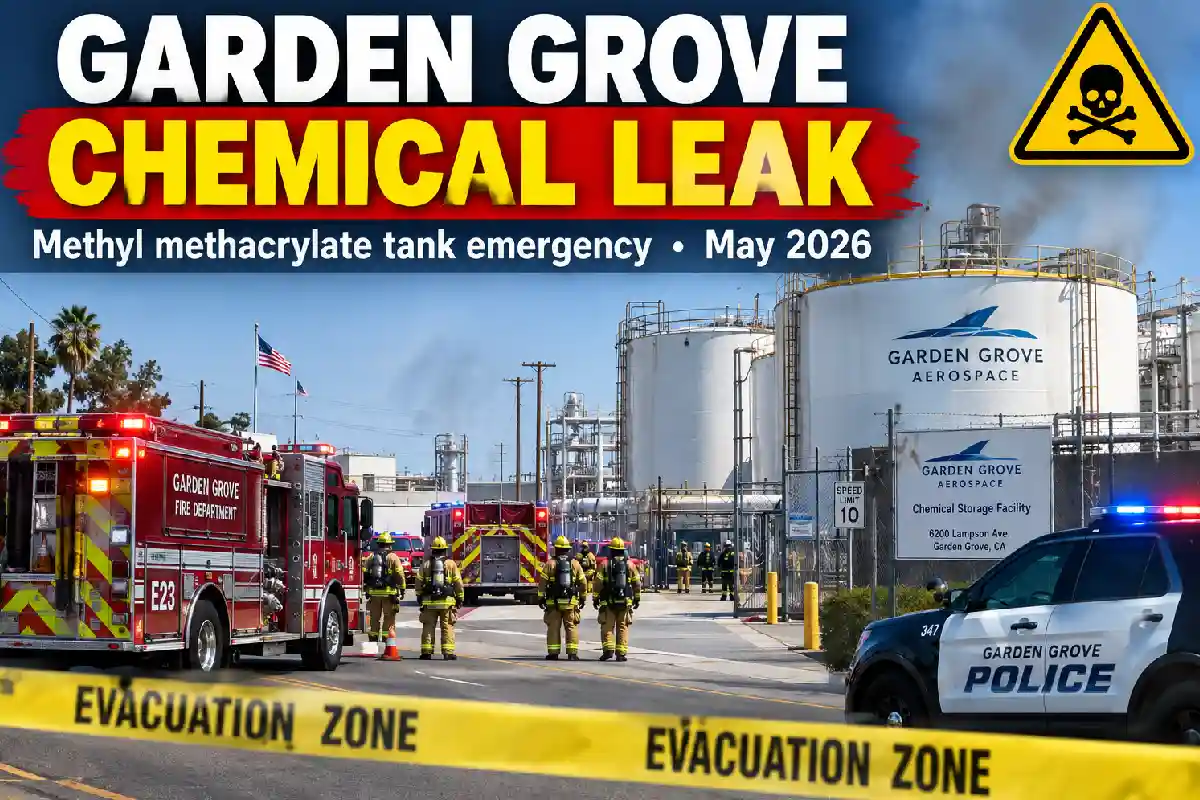
Garden Grove chemical spill has been one of the most vivid cases of emergency dealing with hazardous material in Southern California in 2026. Indeed, the accident took place in the end of May of that year, when MMA chemical tank exploded in GKN Aerospace in Garden Grove, California.
Because of such an accident, it became necessary to give an order of evacuation in order to avoid the explosion or spillage of chemicals. During the period of the peak of the emergency, around 50,000 people had to leave some parts of Garden Grove and neighboring territories.
The situation was alarming since methyl methacrylate is known to be highly flammable and explosive material. Emergency crews managed to keep the tank under control for several days, with the zone of evacuation constantly being adjusted.
What is more important, it was officially stated during the emergency that no traces of any chemical leakage in the air were identified, despite the seriousness of the problem in the tank.
This paper aims to explain what took place during the Garden Grove chemical accident, why the evacuation orders became necessary, what kind of chemical was used, and what information became available afterwards.
What Happened in the Garden Grove Chemical Leak?
This emergency started on May 21, 2026, at a GKN Aerospace plant in Garden Grove, in Orange County, California.
A chemical storage tank filled with between 5,000 to 7,000 gallons of methyl methacrylate had started showing signs of a thermal issue. There was fear that the tank may fail, leak out hazardous material or even explode.
Authorities in the Orange County Fire Authority intervened and a coordinated response involving several organizations was set up.
There was cause for alarm since a chemical release or an explosion could affect the area around it or even other chemical storage facilities.
California declared a state of emergency due to the incident.
Which Chemical Was Involved?
The chemical involved was methyl methacrylate otherwise referred to as MMA.
Methyl methacrylate is a chemical used in the manufacture of plastics and other industrial products. This chemical is highly flammable.
As stated by the reports on the said event, the chemical was stored in the GKN Aerospace plant, which makes aerospace parts such as airplane windows.
It was not a situation where a significant toxic release had occurred initially. The worry here was the potential danger of the overheated tank failing.
Why Were So Many People Evacuated?
Evacuations were called out as a precaution since the situation was a very serious one.
In assessing the condition of the deteriorating tank, authorities issued further orders to protect the citizens from:
- Chemical leaks
- Some toxic vapor
- Fire
- Explosion
At the height of the emergency, about 50,000 people were involved in evacuation orders.
This incident affected the communities around the following cities:
- Garden Grove
- Stanton
- Westminster
- Cypress
- Anaheim
- Buena Park
The reason why the evacuation was necessary is that the potential aftermath of a tank explosion and chemical leak could be very harmful to the surroundings.
Did Any Chemical Leak Occur?
One of the most important queries regarding this case is whether there was a chemical leak that took place.
While responding to this crisis, officials stated that there had not been any major chemical leak in the environment.
Monitoring and stabilizing the situation in the site, the officials were assessing environmental conditions.
Orange County government stated that the monitoring teams had been checking the air and water for any chemicals and declared that there had been none outside the facility.
Where Did the Garden Grove Chemical Incident Occur?
The accident took place at a GKN Aerospace plant in Garden Grove, California.
The first set of evacuation zones was defined on the grounds around the industrial facility.
During the emergency, evacuation zones and road closures were continuously redefined based on the evolving nature of the emergency.
How Did Emergency Crews React?
The reaction to the emergency was quite large, as it involved such organizations as firefighters, hazardous materials specialists, law enforcement agencies, government officials, and other institutions.
Emergency crews acted in order to:
- Control the damaged chemical storage tank
- Prevent explosion
- Lower the temperature of the tank
- Test the air quality
- Control environmental impacts
- Enforce evacuation
- Protect neighboring population and business organizations
The reaction had a unified command because of the complex nature of the emergency.
Why Was There a Risk of an Explosion?
One of the major issues associated with this incident was due to the status of the chemical storage tank.
This chemical storage tank was storing methyl methacrylate which is a highly flammable liquid. Considering the thermal challenges with the tank, the issue that was faced with the tank included pressure and temperature, hence making the tank susceptible to an explosion.
An explosion would have resulted in:
- Fire outbreak
- Vaporization of the chemicals
- Industrial equipment damages
- Other industrial problems
Therefore, the evacuation order became broader as the emergency teams tried to solve the issue.
This was a situation which was taken seriously by the authority as they reported that the danger of the catastrophe was still imminent with the tank being under pressure.
When were the residents allowed to go back home?
The emergency crews managed the evacuation orders as they tried to handle the situation.
The evacuation order started to be lifted on May 21. However, the situation changed whereby the authorities revised the evacuation orders for the affected zones.
Finally, the area where the evacuation order was issued was reduced by the authorities. According to the authorities, the risk of the explosion was eliminated by May 26.
Did the Incident Affect Schools?
Yes. The chemical emergency in Garden Grove impacted the local schools.
Several schools operated under the Garden Grove Unified School District were temporarily shut down due to the ongoing containment efforts and evacuation.
An evacuation zone had been set up around the industrial plant, and school shutdowns took place as a measure to ensure the safety of the pupils and the staff at these institutions.
These schools and district facilities affected by the chemical emergency included elementary schools, intermediate schools, high schools, and other facilities managed by the district.
Was Anybody Hurt?
Media coverage concentrated mainly on the threat posed by the chemical tank and the evacuation.
The emergency response was geared towards preventing injuries to the population before a disaster occurred.
Further reporting of this incident would characterize it as a disaster which involved large scale evacuations; while authorities continued investigating the plant and what caused the emergency.
The fact that there was no reported chemical spillage was crucial for the response effort.
What Happened to the Chemical Tank?
There were changes in the state of the tank during the emergency response activities.
It was later reported that the situation decreased when the officials established that the tank was broken and was no longer pressurized.
This information made the immediate risk of an explosion decrease.
There were further safety measures taken by the facility, and according to reporting, the problem tank was permanently closed down.
Investments in safety enhancements at the facility were reported by both GKN Aerospace and its parent company, Melrose Industries.
Was There Environmental Contamination?
Environmental monitoring became one of the key elements of the emergency response.
It was necessary due to the risks of exposure to methyl methacrylate.
The reports stated that during the major emergency, there were no indications of any release of chemicals into the environment.
Nevertheless, environmental problems were observed after the major emergency.
On June 21st, an incident of 50 gallons of water entering a storm drain was investigated at the GKN Aerospace site. Tests for methyl methacrylate were made.
Environmental investigations take time, and the results of official tests are more accurate than rumors found on the Internet.
Was a State of Emergency Declared?
Yes.
There was a call for state of emergency from the California government due to the chemical accident in Orange County.
A state of emergency was announced, stating the hazardous situation involving the storage tank containing thousands of gallons of methyl methacrylate.
State of emergency announcement helped highlight the threat of hazardous material release and contributed to supporting the emergency process of the state.
How Did It Affect the Community?
State of emergency affected both the community residents as well as the business community.
There was a need to evacuate people in tens of thousands from their homes.
The problems faced by the evacuees were:
- Where to stay
- How to travel
- Meals
- Effect on job
- Effect on education
- Doubts about returning time
These shelters were filled to their maximum due to the huge task of evacuation.
Were Residents Offered Financial Assistance?
After the emergency, announcements for various government and company-funded programs were made.
Orange County had made funding announcements to assist the affected residents in relation to the GKN Aerospace emergency.
The City of Garden Grove also stated that GKN Aerospace was evaluating the possibility of implementing a claims program for those affected by the evacuation process.
Reporting later on indicated that Melrose Industries had declared a claims program worth $100 million for eligible residents and businesses affected by the GKN Aerospace emergency.
The program would take care of some of the expenses in relation to the GKN Aerospace incident.
Was GKN Aerospace Investigated?
The Garden Grove incident led to various investigations.
The processes carried out by the facility and the whole situation in relation to the chemical emergency were investigated by the various government bodies.
Reporting later revealed that the Orange County District Attorney’s office finished their criminal investigation without pressing criminal charges.
Others include the federal bodies and California workplace-safety officials.
What Happened to the GKN Aerospace Facility?
This particular factory of GKN Aerospace had no other choice but to stop its work or decrease the amount of its production after the disaster.
The plant is one of the key manufacturers of aerospace parts, including aircraft windows.
Also, this disaster gained media attention because of the effect that it may have on the supply chain of aerospace industry.
In late August 2026, there were reports that the company would start normal production on September 28, 2026, as long as nothing new would happen.
Why This Garden Grove Chemical Leak Became Such a Nationwide News Story?
There are a few reasons why this particular incident became so huge.
Large-Scale Evacuations
The evacuation process affected some 50,000 people.
Risk of Explosion
The leak from chemical storage created concerns about explosion.
Flammable Chemicals
The chemicals are volatile and flammable.
State of Emergency
California is under a state of emergency.
Impact on the Aerospace Industry
GKN Aerospace plant is a key link of the aerospace industry supply chain.
Garden Grove Chemical Leak Timeline
Date: May 21, 2026
There was an accident involving an industrial chemical at GKN Aerospace in Garden Grove.
Evacuations started while trying to mitigate the situation.
Date: May 22, 2026 – May 23, 2026
A wider evacuation zone came into effect, and many people were forced to leave their houses.
Work on preventing a possible disaster was ongoing.
Date: May 24, 2026 – May 25, 2026
The emergency services continued working on containment procedures.
Zones for evacuation were adjusted.
Date: May 26, 2026
The officials claimed that the possibility of explosion is no longer present, so the people were able to return to their homes.
Date: June 2026
Tests were performed in the area, as well as tests concerning contamination of water in storm drain on the location of the plant.
Date: August 2026
Further information concerning claim procedures and the investigation was provided. The Orange County District Attorney’s Office ended the criminal investigation with no prosecutions. The $100 million claim procedure started for those people who were impacted by the incident.
Final Thoughts
The Garden Grove chemical leak, better referred to as the Garden Grove chemical incident, turned out to be such a serious issue due to the danger of the malfunctioning storage tank which held thousands of gallons of methyl methacrylate.
The situation led to the massive evacuation of 50,000 people, where emergency crews were working day and night to avoid an explosion or any release of dangerous chemicals.
It is important to emphasize that the officials reported no significant chemical release from the storage tank into the air, even though there was a great danger of this happening.
This problem kept going even after the residents went back to their homes, including further environmental testing, investigation, compensation, and facility modifications.
As of the latest major update from 2026, the criminal investigation has ended with no charges, and now there is an opportunity to receive compensation for those residents and businesses who qualify for it and the possible reopening of the facility.
For the current updates, one should follow the City of Garden Grove and other government agencies. City of Garden Grove hazardous materials incident updates. City of Garden Grove hazardous materials incident updates
