
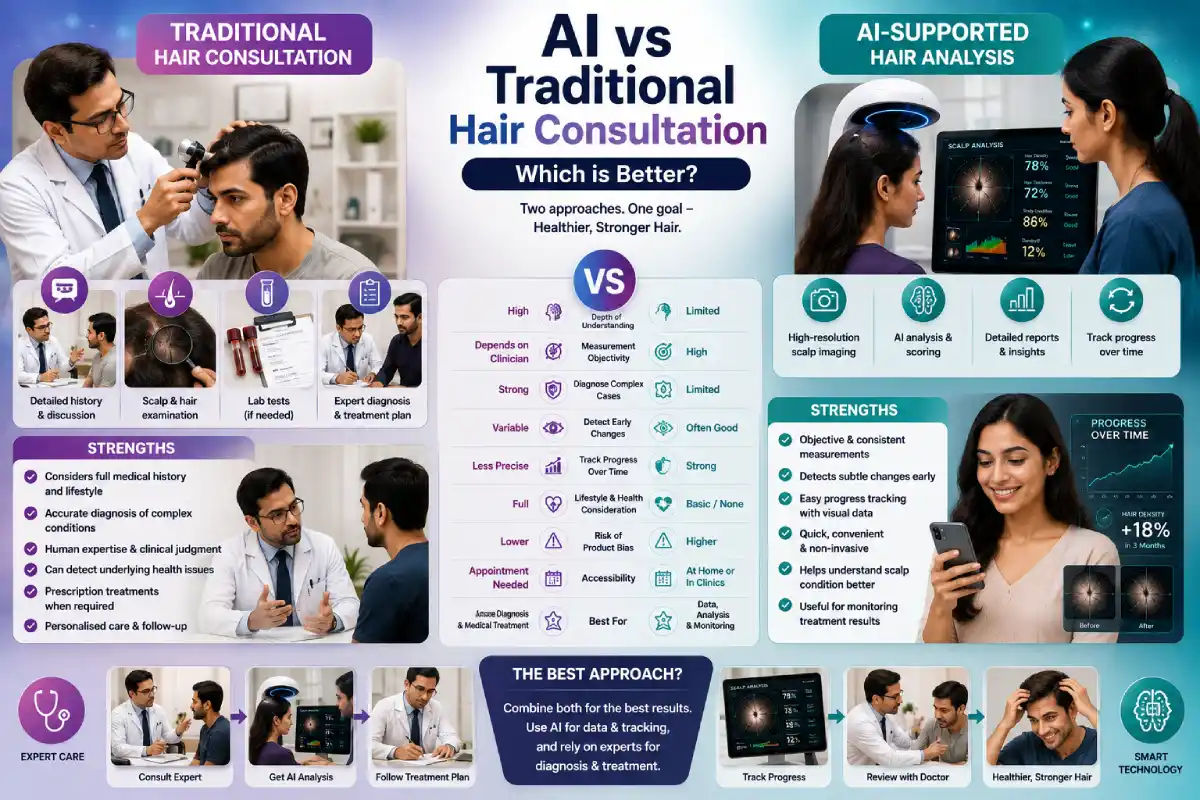
AI vs Traditional Hair Consultation: Which is Better?
When hair starts thinning or falling more than usual, most people want clear answers. For many years the standard route was a traditional consultation with a dermatologist or trichologist. Now AI-powered scalp analysis tools are also available in clinics and through apps. This leads to a natural question: which approach is better?
The truth is that both methods have strengths and weaknesses. One is not automatically superior in every situation. Understanding the differences helps you choose the right path for your needs.
What Happens in a Traditional Hair Consultation
A traditional consultation is led by a trained medical professional. It usually includes several key steps:
- A detailed conversation about your history — family hair loss, stress levels, diet, recent illnesses, medications, hormonal changes, and lifestyle
- Careful visual examination of the scalp and hair under good lighting
- Checking for redness, flaking, scarring, infection, or other visible signs
- Assessment of the pattern of hair loss (temples, crown, overall thinning)
- Ordering blood tests or a scalp biopsy when needed
- Diagnosis based on clinical knowledge and experience
- A personalised treatment plan that may include medical options
The doctor looks at the full picture, not just the scalp surface.
What an AI Hair Consultation Involves
AI-supported analysis uses technology to examine the scalp in a more measured way. This can happen through:
- Professional devices in clinics that use special lighting and high-resolution cameras
- Smartphone apps that analyse regular photos
The AI typically evaluates:
- Hair density in different zones of the scalp
- Thickness of individual hair strands
- Oiliness or dryness levels
- Presence of dandruff or flaking
- Signs of redness or irritation
- Patterns of thinning or miniaturisation
It then produces a report with scores, visual maps, and sometimes product or routine suggestions.
Clear Comparison Between the Two Approaches
| Aspect | Traditional Consultation | AI-Supported Analysis |
|---|---|---|
| Depth of medical understanding | High – considers full health context | Limited – mainly image-based |
| Objectivity of measurements | Depends on the clinician | High – consistent numerical data |
| Ability to diagnose complex cases | Strong | Limited |
| Detection of early subtle changes | Variable | Often good with quality imaging |
| Tracking progress over months | Possible but less precise | Strong – easy side-by-side comparisons |
| Consideration of lifestyle & health | Full | Basic or none |
| Risk of product bias | Lower with independent doctors | Higher with many commercial tools |
| Accessibility | Requires appointment | Some options available at home or in salons |
| Best suited for | Accurate diagnosis and medical treatment | Extra data and ongoing monitoring |
Strengths of Traditional Consultation
Traditional consultation remains the stronger choice in several important areas.
It considers the complete person. Hair loss can be linked to iron deficiency, thyroid issues, hormonal changes, stress, medication side effects, or autoimmune conditions. A doctor can investigate these factors properly.
It handles unusual or complex cases better. Not all hair loss is simple pattern baldness. Conditions such as alopecia areata, scarring alopecias, or telogen effluvium need proper medical recognition.
It allows prescription treatments when appropriate. Many effective options require medical supervision.
It offers human judgment and reassurance. A good doctor can explain the situation clearly and adjust the plan based on how you respond.
Strengths of AI Analysis
AI brings useful advantages that traditional methods sometimes lack.
It provides objective numbers. Instead of descriptions like “moderate thinning,” you get measurable data on density and thickness. This makes progress easier to track.
It can highlight details that are hard to see with the naked eye, especially with specialised lighting and magnification.
It supports consistent monitoring. Repeating the same scan after three or six months gives a clearer picture of whether a treatment is helping.
It is convenient for basic checks. Some tools can be used at home between clinic visits.
It helps with patient education. Visual reports make it easier for people to understand their scalp condition.
Where AI Has Clear Limits
AI tools cannot replace medical expertise. They do not order or interpret blood tests. They cannot fully assess hormonal or systemic causes. They may miss rare or complex conditions. Recommendations are often linked to specific brands, which can create bias. Results also depend heavily on the quality of the images or scan.
Where Traditional Methods Can Be Improved
Traditional consultations sometimes vary between doctors. Progress tracking can be less precise without measurements. In busy clinics, time for detailed discussion may be limited. Very early changes can occasionally be overlooked.
Which Approach Is Better for Different Situations?
Choose a traditional consultation first when:
- Hair loss is sudden or severe
- You have other symptoms such as fatigue, weight changes, or skin problems
- You need a proper medical diagnosis
- You want access to prescription treatments
- The cause may be more complex than common pattern thinning
AI analysis adds value when:
- You want clear baseline measurements
- You are already on a treatment and want to track progress objectively
- You would like visual data to discuss with your doctor
- Your situation appears to be typical pattern hair loss and you want supporting information
The most effective approach for many people is to combine both. Use AI tools for measurements and monitoring, and rely on a qualified doctor for diagnosis and treatment decisions.
Practical Advice for Patients
- If you are worried about hair loss, start with a dermatologist or trichologist.
- Ask whether the clinic offers AI scalp analysis as part of the consultation — it can provide useful extra data.
- Treat at-home AI apps as basic monitoring tools, not as diagnostic replacements.
- Always share any AI reports with your doctor.
- Focus on consistent treatment and good scalp care. Technology supports these efforts but does not replace them.
- Be patient. Meaningful improvement in hair density usually takes several months.
Final Balanced View
AI is making hair loss assessment more precise and easier to track. It brings objectivity and helpful visual data. Traditional consultation remains superior for accurate diagnosis, medical judgment, and complete patient care.
Neither method is perfect on its own. The smartest choice is to use AI as a supporting tool while keeping a qualified doctor at the centre of the process. This combination gives you the clarity of technology and the reliability of medical expertise.
If you are dealing with hair thinning or increased fall, a proper medical consultation is still the most important first step. AI can then help you and your doctor monitor progress more clearly over time.
