
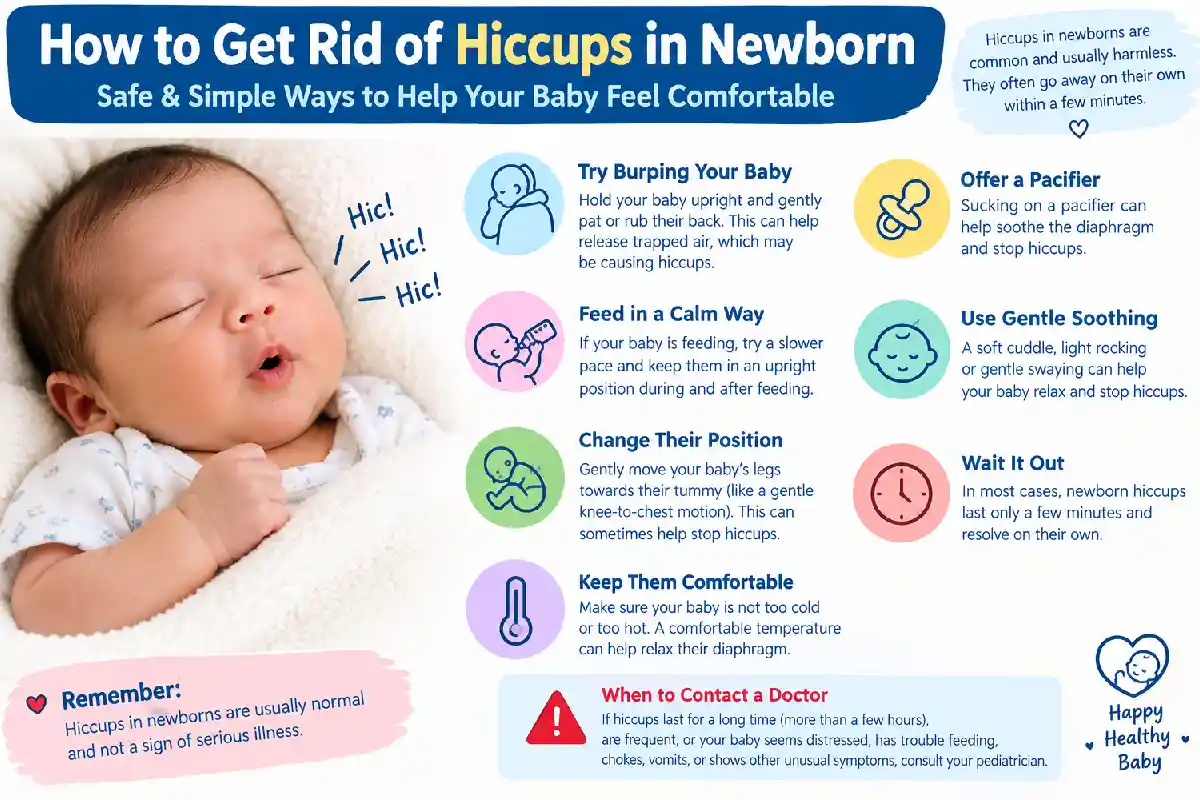
Baby hiccups may come as a surprise for new parents. Hiccups in infants appear unexpectedly and produce short hiccup-like sounds one after another while feeding, after feeding, or even sleeping.
However, baby hiccups are a rather common phenomenon; in most cases, hiccups are not dangerous and disappear on their own. As pointed out by the American Academy of Pediatrics, hiccups are more disturbing for parents than for children.
How to stop baby hiccups?
Usually, no action is required at all. But if hiccups occur during feeding and disturb the baby, changing the baby’s position, taking a short break, and burping the baby may help.
This page provides information about causes of baby hiccups, the safest way to treat hiccups in babies, what not to do, and when to consult the doctor.
Warning: The information presented in this article is general and cannot replace medical advice from a pediatrician.
Are Hiccups Normal in Newborns?
Yes, hiccupping is common among newborn babies and infants.
It is very common in infants, especially in their early stages. The hiccups may happen:
- While the baby is taking food
- After taking food
- During intake of air by the baby
- Full stomach
- When the baby is playing or sleeping
Fortunately, hiccups do not have any negative impact on infants.
Causes of Hiccups in Infants
The sudden contraction of the diaphragm muscle causes hiccups.
The diaphragm is a muscle located just below the lungs and plays a major part in the breathing process.
The sudden contraction results in the fast closing of the vocal cords, leading to hiccups.
In case of the new born babies and infants, hiccups are associated with feeding and swallowing air.
The causes are:
- Milking too quickly
- Air intake while feeding
- Overfeeding
- Full stomach
- Feeding when in a fussy condition
Infants swallow much air while feeding fast or when fussy.
How to Get Rid of Hiccups in Newborns
It is impossible to stop babies from hiccuping instantly.
Luckily, most of the time they will stop themselves.
Should your baby have hiccups, you may want to consider some actions described below. All of them are very safe and gentle.
1. Wait and Watch
In some cases, waiting might be enough.
Hiccuping usually passes naturally in newborn babies.
According to Pregnancy, Birth and Baby, baby hiccups usually go away without any action by parents in a matter of minutes.
If your baby is:
- Breathing normally
- Behaving well
- Eating normally
- Moving normally
There is nothing to worry about.
2. Stop the Feeding Process
In case the baby starts hiccuping while being fed, it is recommended to stop feeding.
According to the American Academy of Pediatrics, parents should switch the position of their baby and help them burp in case of hiccups during feeding.
Taking a break from feeding:
- Slows down the process of feeding
- Prevents the baby from overfeeding and gulping
- Enables the baby to release some air
- Allows the baby to have some rest
Never force your baby to feed.
3. Burp Your Baby
Burping could be helpful in cases where the problem is associated with air swallowing.
Infants can swallow air in both nursing and bottle feeding.
The American Academy of Pediatrics suggests regular burping of infants, especially when they swallow air while feeding. It can be helpful for bottle-fed infants after about 2-3 ounces, while breastfed infants should be burped whenever there is a change in the breast.
How to Burp a Baby
There are various methods of doing so.
On Your Shoulder
Position your baby in an upright position with their back resting against your shoulder.
Hold:
- Their head
- Their neck
- Their back
Pat or rub their back gently.
On Your Lap
Position your baby on your lap with their head and chest supported.
Position them in a forward-leaning position, and pat or rub their back.
On Your Lap
Lay your baby down across your lap with proper head support.
Pat or rub their back gently.
4. Change Your Baby’s Position
If hiccups start during feedings, a change in your baby’s posture may be effective.
Try holding your baby in an upright position.
This posture may help to slow down the feeding process and minimize air intake.
According to the American Academy of Pediatrics, it is necessary to change the baby’s posture and help them relax during hiccups while feeding.
Support your baby properly at all times.
5. Feed Your Baby While They Are Calm
One of the possible ways of reducing frequent hiccups is avoiding feeding your baby only when they become extremely hungry and start to cry.
An extremely hungry baby may suck milk faster and therefore take in more air.
According to the American Academy of Pediatrics, it is advisable to feed babies while they are still calm and not too hungry to prevent hiccups during feedings.
Watch out for your baby’s first signs of being hungry, which may include:
- Their head moving towards the breast or the bottle
- Their opening their mouth
- Their hands moving towards the mouth
- Their becoming more alert
6. Slow Down the Feeding
Feeding your baby rapidly may cause the volume of swallowed air to become larger.
If the baby is bottle-fed, you may have to ensure that formula is not being released too quickly.
If your baby drinks the bottle fast, it may be useful to pause feeding.
Slower feeding can:
- Help to reduce gulping
- Reduce swallowing air
- Provide the chance to relax
You can always contact your pediatrician or baby feeding specialist in case you have any questions regarding feeding practices and bottle nipples.
7. Use Pacifier if Baby Is Pacifier-Dependent
Some babies can be relaxed by means of a pacifier.
Sucking may help to relax the diaphragm of your baby. According to the Cleveland Clinic, using a pacifier can help prevent hiccups in your baby.
However, hiccups do not require any treatment.
Do not force your baby to use a pacifier if he does not want it.
Parents must also ask specialists about how to use the pacifier properly.
What Should You NOT Do for Newborn Hiccups?
The majority of adults resort to home remedies in order to stop hiccups.
Nevertheless, most of these home remedies are not applicable in curing babies’ hiccups.
Do Not Cure Babies’ Hiccups Using Remedies Used by Adults
Babies should never be cured of hiccups using the same remedies that adults apply unless recommended by a medical doctor.
Avoid curing babies’ hiccups by forcing them to drink cold water.
Do Not Startle a Baby
One should avoid trying to scare or startle babies in an attempt to cure their hiccups.
This can be not only ineffective but may also be disturbing for the babies.
Do Not Hinder a Baby from Breathing
Do not hinder your baby from breathing in order to cure their hiccups.
Do not:
- Constrict the nose of the baby
- Force the baby to breathe through the mouth by covering its mouth
- Blow the air out of the baby’s mouth
It is dangerous.
Do Not Apply Any Choking Substances
Never attempt to cure a baby’s hiccups by giving them choking substances.
Do Not Apply Home Remedies for Adults
Some home remedies, such as:
- Lemon
- Vinegar
- Spicy food
- Sugar
are not suitable for curing babies’ hiccups.
Why Does My Baby Get Hiccups After Feeding?
Post-prandial hiccups are very common.
These may be caused by:
- Air swallowing
- Feeling full quickly
- A full stomach
- Diaphragm changes during feeding
According to the American Academy of Pediatrics, babies can swallow air while feeding. Burping is one of the methods to avoid swallowing air.
Steps:
- Make your baby feed calmly.
- Take breaks.
- Burp the baby while feeding.
- Burp the baby after feeding.
Keep in mind that your baby does not necessarily need to burp after each feeding session.
How to Avoid Hiccups in Babies
Not all hiccups can be prevented.
However, there are some feeding methods that can reduce the occurrence of frequent hiccups.
Feed Your Baby Before Getting Too Hungry
It would be ideal if you can detect the signs that your baby feels hungry.
When calm, the baby will feed slowly and swallow less air.
Burp the Baby During Feedings
Take some pauses and burp your baby.
This will reduce air swallowing.
Do Not Rush the Baby While Feeding
Let your baby feed calmly and at their pace.
When Should You Call a Doctor?
Nevertheless, if your newborn experiences hiccups along with certain other symptoms, you need to visit your newborn’s doctor.
Seek medical advice from your doctor in case your baby shows:
- Having problems with feeding
- Having uncontrollable vomiting
- Low weight gain
- High irritability when feeding
- Persistent arching of the back
- Persistent coughing when feeding
If your newborn experiences uncontrollable vomiting, it is better to visit a pediatrician.
Can Hiccups Be Harmful To My Newborn Baby?
No.
On the whole, hiccups are not dangerous for babies.
According to the American Academy of Pediatrics, most babies experience hiccups regularly, and parents are much more worried about them than babies.
Your baby will keep on:
- Sleeping
- Eating
- Behaving normally
even though he experiences hiccups.
Final Thoughts
The easiest way to treat hiccups in infants is to do nothing, since hiccups in infants disappear spontaneously.
If hiccups occur when feeding your baby, you might try:
- Taking a break during feeding
- Changing the position of your baby
- Burping your baby
- Making your baby relaxed
- Feeding your baby before they get very hungry
These easy tips will help reduce the amount of air swallowed by your baby during feeding.
Never use hiccups cure methods for adults, do not disturb your baby while they are having hiccups, and do not try any medicines or products without consulting your baby’s pediatrician.
Lastly, note the general health state of your baby. Although hiccups are generally safe on their own, when they are combined with breathing difficulties, feeding problems, forceful vomiting, or lack of weight gain, you need to consult a pediatrician.
For the majority of parents, a newborn’s hiccups are just one of the many harmless things.
