
How AI is Changing Hair Loss Diagnosis and Treatment
Hair loss affects millions of people. For a long time, diagnosis depended mostly on a doctor’s visual examination, questions about family history, and sometimes blood tests or a small scalp biopsy. Treatment was often based on standard options that worked for many but not for everyone.
In 2026, artificial intelligence is starting to change both diagnosis and treatment planning. AI tools can analyse scalp images in detail, help detect patterns of hair loss earlier, and support more personalised recommendations. This does not replace doctors, but it is making the process clearer and more data-based for many patients.
This article explains the main ways AI is being used in hair loss care today, what it can do well, and where human expertise is still essential.
How Hair Loss Diagnosis Worked Before AI
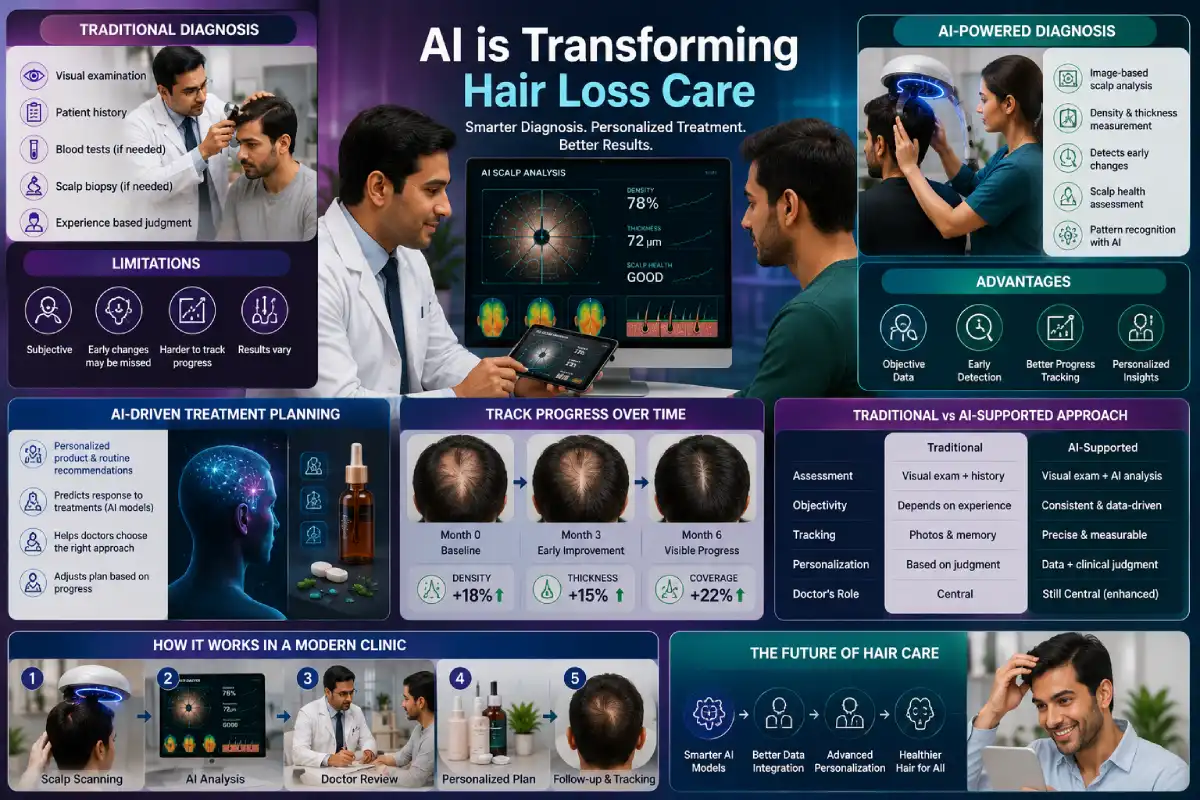
Traditional diagnosis usually involved:
- Looking at the pattern of thinning (temples, crown, overall diffuse loss)
- Checking for redness, scaling, or scarring on the scalp
- Asking about family history, stress, diet, medications, and hormonal factors
- Sometimes ordering blood tests or a biopsy
This approach works well in experienced hands, but it can be subjective. Early changes are easy to miss, and progress tracking often relied on memory or simple photos.
How AI is Improving Diagnosis
AI systems are trained on large numbers of scalp images. They learn to recognise patterns linked to different types of hair loss.
Key ways AI helps in diagnosis:
Detailed image analysis
Special cameras or even smartphone photos can be analysed for:
- Hair density in different zones
- Thickness of individual hairs
- Signs of miniaturisation (hairs becoming thinner)
- Scalp inflammation or oiliness
- Areas of reduced coverage
More objective measurements
Instead of only descriptive terms, AI can give numerical scores for density and thickness. This makes it easier to compare results over time.
Support for early detection
Some tools claim to pick up subtle changes before they become obvious to the naked eye. Early detection can lead to earlier intervention.
Pattern recognition
AI can help classify common patterns such as male or female pattern hair loss and flag features that may need further medical investigation.
Professional devices (such as certain salon or clinic scanners) and some specialised apps are the main tools currently in use.
AI in Treatment Planning
Once a clearer picture of the scalp is available, AI can support treatment decisions in several ways:
Personalised recommendations
Based on the analysis, systems may suggest specific topical treatments, lifestyle adjustments, or combinations that match the individual’s pattern and scalp condition.
Progress tracking
Repeated scans allow both the patient and the doctor to see whether density or thickness is improving, stable, or worsening. This helps decide whether to continue, adjust, or change a treatment.
Support for clinical decisions
In some research and advanced clinics, AI models help predict which patients are more likely to respond to certain therapies. This is still developing but shows promise.
Assistance in procedures
In hair transplantation, AI and robotics are beginning to help with planning and precision, although the surgeon remains in control.
Benefits of AI in Hair Loss Care
| Benefit | How It Helps Patients |
|---|---|
| More objective data | Clear numbers instead of only visual impression |
| Better tracking over time | Easier to see if a treatment is working |
| Earlier insights | Potential to notice changes sooner |
| Support for personalisation | Routines and treatments matched more closely to the individual |
| Patient education | Visual reports help people understand their condition |
Important Limitations
AI is a powerful helper, but it has clear limits:
- It cannot replace a full medical evaluation. Blood tests, medical history, and physical examination by a doctor are still essential.
- Not all hair loss is pattern baldness. Conditions such as alopecia areata, scarring alopecias, or hair loss caused by illness need proper medical diagnosis.
- Image quality matters. Poor photos or incorrect scanning technique can lead to less reliable results.
- Many tools are linked to specific brands or clinics, so recommendations may favour certain products.
- AI predictions about future hair loss or treatment response are still imperfect.
The best results come when AI tools are used together with a qualified dermatologist or trichologist.
Comparison: Traditional vs AI-Supported Approach
| Aspect | Traditional Approach | AI-Supported Approach |
|---|---|---|
| Assessment method | Visual exam + history | Visual exam + detailed image analysis |
| Objectivity | Depends on clinician experience | More consistent measurements |
| Tracking progress | Photos and memory | Numerical scores and side-by-side comparisons |
| Personalisation | Based on clinical judgment | Data + clinical judgment |
| Accessibility | Clinic visit | Clinic devices + some home apps |
| Role of doctor | Central | Still central, supported by data |
What Patients Can Expect in Practice
In clinics that use AI tools, a typical process may look like this:
- Scalp is examined and scanned with a specialised device or high-quality imaging.
- AI generates a report with measurements and visual maps.
- The doctor reviews the report together with the patient’s history and any test results.
- A treatment plan is created (topical treatments, medications, procedures, or a combination).
- Follow-up scans help measure progress after several months.
At-home apps can offer basic analysis and tracking, but they are generally less detailed than professional systems.
Practical Advice for Anyone Considering AI Tools
- Use AI analysis as extra information, not as a final diagnosis.
- Choose reputable clinics or validated tools when possible.
- Share the AI report with your doctor rather than relying on it alone.
- Focus on consistent treatment and scalp care — technology supports these efforts but does not replace them.
- Be patient. Hair growth is slow, and meaningful changes usually take months.
The Future Direction
AI is likely to become more accurate as larger and more diverse datasets are used for training. We can expect better integration between image analysis, medical history, and treatment outcomes. Home tools may also improve, making basic monitoring easier between clinic visits.
At the same time, the human role will remain important. Empathy, clinical experience, and the ability to consider the whole patient cannot be fully automated.
Final Thoughts
AI is making hair loss diagnosis more precise and treatment planning more personalised. Detailed scalp analysis, objective measurements, and better progress tracking are real improvements that help both doctors and patients.
The technology works best as a support tool. When combined with proper medical care, consistent treatment, and realistic expectations, AI can contribute to clearer understanding and better management of hair loss.
If you are dealing with thinning or hair fall, an AI-supported assessment in a good clinic can be a useful step — provided it is part of a complete medical approach rather than a standalone solution
