
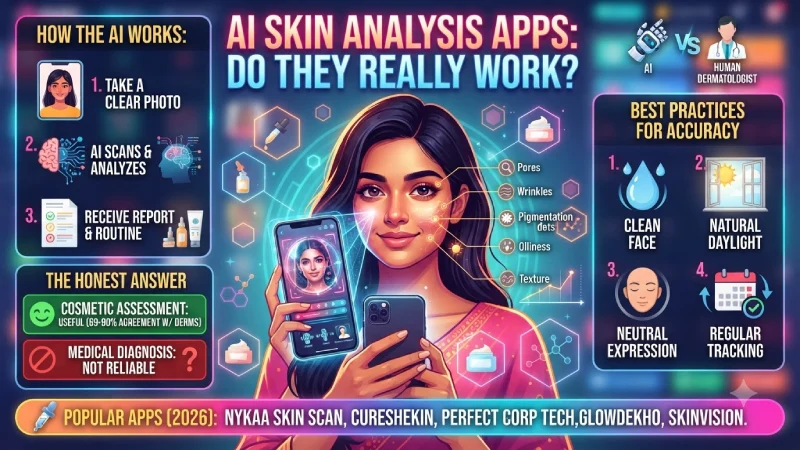
AI Skin Analysis Apps: Do They Really Work?
You open an app, take a selfie, and within seconds it tells you about your pores, dark spots, wrinkles, oiliness, and even suggests a full routine. It looks impressive. But the big question remains: do these AI skin analysis apps actually work?
In 2026, these tools are everywhere. Many beauty brands, shopping apps, and independent platforms offer them. Some people find them helpful. Others feel the results are generic or push products too hard. This article takes a clear, balanced look at how they work, what they can do well, where they fall short, and reviews some popular options.
How AI Skin Analysis Apps Work
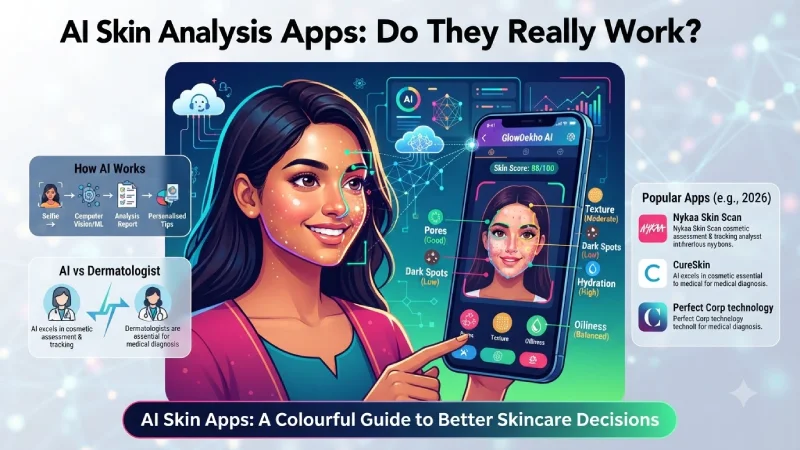
Most apps follow a similar process.
- You take a clear photo of your face (sometimes multiple angles).
- The AI studies the image using computer vision and machine learning models trained on thousands or millions of skin photos.
- It measures or scores things like:
- Pore visibility
- Fine lines and wrinkles
- Dark spots and pigmentation
- Redness
- Oiliness or shine
- Texture and smoothness
- Estimated hydration
- It gives you a report, sometimes with scores, a visual map, and product suggestions.
Some advanced tools also ask a few questions about your age, climate, lifestyle, or concerns to improve the results.
The technology has improved a lot, especially in reading a wider range of skin tones. Still, the quality of your photo matters more than most people realise.
Do They Really Work? The Honest Answer
For general cosmetic assessment – often useful.
Studies show AI can agree with dermatologists on many visible features (pores, wrinkles, pigmentation, redness) in roughly 69% to over 90% of cases, depending on the tool and the specific concern. This is better than most people guessing their own skin type (self-assessment is often only around 40% accurate).
For tracking changes over time – one of their strongest uses.
If you scan under similar lighting every few weeks, the app can show whether your skin is improving or not. This feedback is hard to get otherwise.
For medical diagnosis – no.
These consumer apps are not reliable for detecting skin cancer, infections, or complex conditions. Research has shown mixed and sometimes poor results when apps try to diagnose medical issues. Experienced dermatologists still outperform AI in real-world complex cases. Apps should never replace a doctor.
Photo quality is critical.
Bad lighting, filters, makeup, or a blurry photo can give wrong readings. Natural daylight near a window usually works best.
Product recommendations are mixed.
Many apps are linked to brands or marketplaces, so suggestions often favour products they sell. The analysis itself may be decent, but the shopping list needs extra checking.
Popular AI Skin Analysis Options in 2026
Here is a practical look at some widely used tools (especially relevant for Indian users).
| App / Tool | Main Focus | Strengths | Limitations | Best For |
| Nykaa Skin Scan | Cosmetic analysis + product suggestions | Easy access in India, multiple parameters | Strong product push | Quick everyday check |
| CureSkin / Cureskin | Skin & hair analysis + treatment plans | Doctor-backed options, Indian focus | More treatment-oriented | People wanting guided plans |
| GlowDekho | Free analysis for Indian skin | Built for Indian climate & tones, free | Newer platform | Budget-friendly starting point |
| Perfect Corp technology | Used by many brands | Dermatologist-validated in studies, detailed | Often brand-linked | Accurate cosmetic scoring |
| PerfectSkin (DeepSense) | Indian skin focus | Climate and tone aware | Product recommendations | Localised advice |
| SkinVision & similar | More medical / mole checking | Some clinical studies | Not for general skincare | Mole monitoring (with caution) |
Note: Features and availability change. Always check the latest version and privacy policy.
What These Apps Usually Get Right
- Detecting visible shine and oiliness patterns
- Highlighting pigmentation and dark spots
- Measuring pore visibility
- Showing relative changes when you scan regularly
- Giving a clearer picture than pure self-guessing
What They Often Struggle With
- Accurate medical diagnosis
- Distinguishing similar-looking conditions
- Working perfectly across all lighting conditions
- Avoiding bias if the training data was limited
- Giving fully neutral product advice
How to Get Better Results from Any AI Skin App
- Wash your face and wait 20–30 minutes so no products remain.
- Use natural daylight. Avoid yellow bulbs or strong shadows.
- Keep a neutral expression and face the camera straight.
- Take more than one photo if the app allows.
- Scan at similar times of day for tracking.
- Read the full report, not only the product list.
- Cross-check suggestions with basic skincare knowledge.
Realistic Expectations for Indian Users
Indian skin often deals with pigmentation, combination patterns, humidity effects, and pollution. Some newer apps claim better training on South Asian skin tones and local climate factors. This is a positive step. Still, results vary. What works well for one person may feel average for another.
Many Indian users find these tools helpful as a starting point, especially when combined with simple routines and sunscreen.
Comparison: AI App vs Dermatologist Visit
| Aspect | AI Skin Analysis App | Dermatologist Visit |
| Speed | Seconds to minutes | Appointment needed |
| Cost | Free or low | Higher |
| Convenience | At home anytime | Clinic visit |
| Depth for cosmetic concerns | Good | Excellent |
| Medical diagnosis | Not reliable | Reliable |
| Personal context | Limited | Full history and examination |
| Product neutrality | Often commercial | More independent |
Best approach for most people: use the app for everyday guidance and tracking, and see a doctor for persistent or serious issues.
Common Mistakes People Make
- Trusting the app completely and ignoring how their skin actually feels
- Scanning with makeup or right after applying products
- Buying every recommended product immediately
- Using the app only once instead of tracking over time
- Expecting medical-level accuracy
Final Balanced View
AI skin analysis apps do work for what they are designed for — giving a quick, data-based look at visible skin features and helping people move beyond pure guesswork. They are better than nothing and often better than self-assessment alone. They are especially useful for tracking progress and getting a clearer starting point.
They are not magic. They are not doctors. Photo quality, lighting, and the commercial side of recommendations all affect the experience.
If you use them with realistic expectations, they can be a helpful part of modern skincare. Start with a free or easily available tool, follow the photo tips, and treat the results as guidance rather than final truth. Over time, you will see whether the insights actually help your skin.
