
Last Updated: September 7, 2026
Marketing has always been dependent on insight into human nature, human needs, interests, and actions. The only difference in comparison to any other period is that we have lots of data about our customers.
The use of artificial intelligence will allow company owners to analyze customer behaviors, generate personalized content, automate boring tasks, personalize communications, and optimize campaigns by taking into account the performance data. Marketers will have a chance to analyze large sets of data and find out specific patterns of customer behaviors.
AI marketing does not make the need for developing marketing strategies unnecessary. The use of AI will allow marketers to spend more time making decisions and analyzing large volumes of data.
What Is AI Marketing?
AI marketing is the use of artificial intelligence technologies to conduct marketing activities.
Such technologies as machine learning, predictive analytics, natural language processing, generative AI, and even autonomous AI agents can be used in marketing.
Instead of manual analysis of tens of thousands of interactions with customers, the software will be able to analyze this information automatically.
The following are some of the potential uses of the insights by a marketing team in order to:
- Ideally identify customer segments
- Create personalized email campaigns
- Make product recommendations
- Suggest ideas for content
- Conduct a campaign analysis
- Forecast consumer behavior
- Automate marketing processes
It is not only important for marketers to incorporate artificial intelligence into their workflow, but it should be done with the sole aim of solving problems.
How Does AI-Powered Marketing Work?
AI-powered marketing normally begins with data.
This may include data from websites, CRM systems, email campaigns, advertising platforms, social media, ecommerce, among others.
The data will then be analyzed by the AI system and used to create insights, which are then employed to create recommendations and automated marketing actions, depending on the platform.
An AI marketing process would follow the sequence below:
Customer data → AI analysis → Audience insight → Personalized action → Performance analysis → Optimization
For instance, if an ecommerce business realizes that customers who keep looking at a certain category have a higher likelihood of purchasing those products, AI will be used to optimize future recommendations and communication actions.
Benefits of AI-Powered Marketing
Businesses adopt AI marketing tools for several practical reasons.
| Benefit | How AI Can Help |
| Efficiency | Automates repetitive marketing tasks |
| Personalization | Creates more relevant customer experiences |
| Analytics | Processes large amounts of marketing data |
| Scalability | Helps teams manage larger campaigns |
| Content | Speeds up ideation and content production |
| Optimization | Identifies patterns and performance opportunities |
For example, Amazon Ads offers AI marketing as a way to enhance efficiency, relevancy, scalability, and creativity.
Key Uses of AI in Marketing
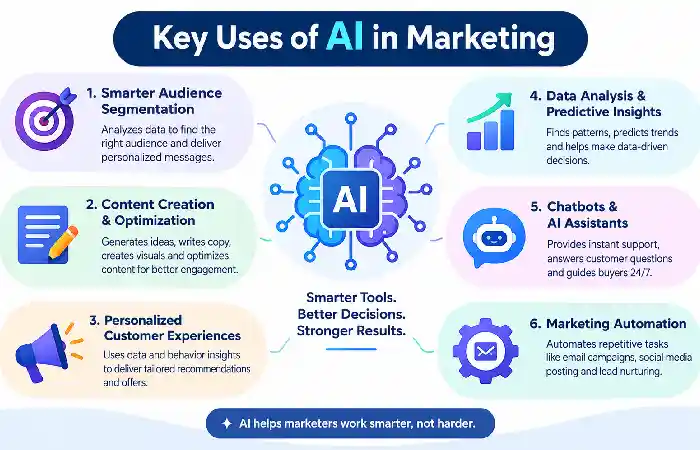
AI can be utilized in almost all the stages of the digital marketing process.
1. Content Creation
Generative AI will assist marketers in creating drafts of blog articles, product descriptions, emails, social media content, advertisements, and other marketing texts.
This will help save time since the team will require different variations of the same content.
It is important to remember that the generated content requires human validation.
Marketers must make sure that the facts, style of communication, originality, and actual usefulness of the content are verified.
2. Customer Personalization
Customer personalization is probably one of the most valuable uses of AI in marketing.
By using various data such as browsing, purchase history, content interaction, and preferences, AI will assist businesses in creating more personalized experiences for customers.
For example, the online store may suggest different products for different customers based on their past interactions.
In the same way, the email service can use customers’ behavior in order to choose the relevant content/offers.
3. Marketing Automation
Traditional automation is done based on rules set by the marketer.
For instance:
When someone subscribes to something → send a welcome email.
With AI-powered automation, there will be an ability to analyze the customer’s actions and determine the best course of action.
AI marketing automation is able to make use of customer actions on different channels to find trends, segment the audience, personalize the communication, and time it accordingly.
This may result in less manual effort needed for the management of big campaigns.
4. Advertising Optimization
Paid advertising produces huge amounts of performance data.
AI can be useful in analyzing all this data and finding out any patterns in the audiences, creative variations, bids, placements, and conversions.
More and more AI capabilities have been integrated by the advertising platforms for targeting and campaign management.
However, marketers need to set their objectives and track performance.
5. Predictive Analytics
Predictive analytics utilizes historical data as well as current data to make predictions about what will happen in the future.
Some applications of predictive analytics in marketing include:
- Lead scoring
- Customer retention
- Purchase prediction
- Churn analysis
- Demand forecasting
- Campaign effectiveness
- Customer segmentation
For instance, an AI tool would detect customers exhibiting behaviors that predict higher purchase intention.
This will enable marketers to concentrate their efforts where they matter most.
6. Search Engine Optimization and Content Optimization
AI can also assist in search engine optimization (SEO).
The following can be done by marketers using AI-powered SEO tools:
- Analyzing search intent
- Finding content gaps
- Topic organization
- Outline creation
- Content audit
Nonetheless, marketers should not consider using AI to quickly generate low-value pages.
The following factors are important for effective SEO: knowing your audience, giving them valuable information, being accurate, and structuring the website effectively.
7. Customer Service and Chatbots
AI chatbots will be able to provide answers to some common queries made by customers and help customers even if the company is closed.
In case of simple customer needs, it will be more effective.
Nevertheless, in case of more complex and sensitive questions, there must always be an opportunity for customers to contact a live representative.
The best thing is when a customer is helped by a live representative after an automated process for a simpler request.
AI-Powered Marketing for Small Businesses
It does not require a large marketing team to implement AI.
One can start with one or two simple tasks.
For example:
Content: Generate article and social media ideas using AI.
Email: Analyze customer engagement and develop personal campaigns.
Customer Service: Develop a chatbot to reply to common questions.
Analytics: Carry out AI-assisted reporting to discover unusual changes in traffic and conversion.
Advertising: Carry out automated ad campaigns on different platforms.
The idea is to start with a particular problem instead of purchasing different AI products just because they are trendy.
How to Build an AI Marketing Strategy
Implementing AI without a strategy may make the situation even worse.
Instead, the following steps need to be taken.
Define the Goal
First of all, determine which area you need to improve.
It can be:
- Generation of more qualified leads
- Higher conversion rates
- Fast content creation
- Lower customer acquisition costs
- Better retention
- Efficient reporting
Identify the Data
Figure out which customer and marketing data is available.
The poor quality or insufficient amount of such data may influence the efficiency of recommendations generated through the use of AI.
Choose the Correct Use Case
Not everything can be automated at once.
Choose one process which needs to be improved with the help of AI.
Human Oversight
AI-generated recommendations and content should be checked by people familiar with the company.
It is especially true for customer communication, brand communication, sensitive data, and factual content.
Measure the Effectiveness
Measure business metrics before and after the implementation of AI solutions.
Depending on the campaign, the metrics may be:
- Conversions
- Sales
- ROAS
- CPL
- Customer retention
- Engagement in emails
- Organic traffic
- Customer satisfaction
Salesforce suggests using AI analytics to measure attribution, performance, and customer insights, not just activity metrics.
AI-Powered Marketing and Traditional Marketing
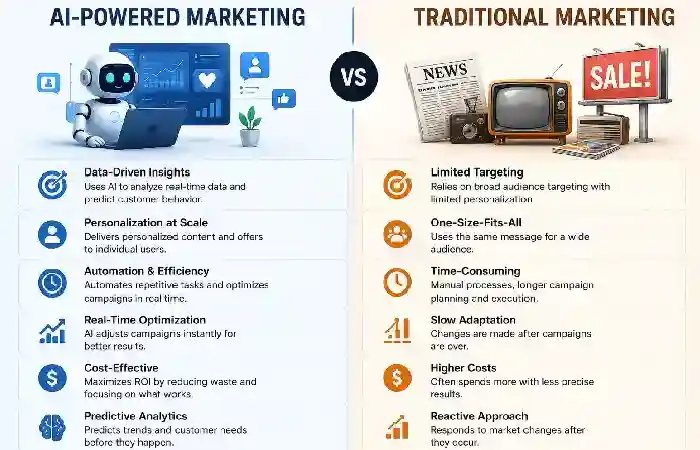
AI-based marketing does not substitute traditional marketing techniques.
Rather, these two strategies can be combined.
| Traditional Approach | AI-Powered Approach |
| Manual audience analysis | Automated pattern analysis |
| Rule-based segmentation | Predictive segmentation |
| Manual content variations | AI-assisted content generation |
| Scheduled campaigns | Behavior-based optimization |
| Periodic reporting | Faster data analysis |
| Broad personalization | More dynamic personalization |
Challenges of AI-Powered Marketing
There are many opportunities for AI, but there are also several downsides.
Data Privacy
The marketing system can collect huge quantities of data about customers. It requires proper practices for using and storing the data, permission, and safety measures.
Inaccuracy
AI can provide false data or suggestions if the underlying data is not correct.
Brand Voice
AI content can be quite generic if it lacks an understanding of brand voice and human review.
Over-Automation
If every customer interaction is automated, a brand will appear impersonal.
Humans are preferred when it comes to complex problems.
Measuring True Business Growth
Creating more content and performing all activities automatically is not equal to business growth.
The essential thing is how much AI helps a business reach valuable goals.
Best Practices for Using AI in Marketing
Here are several fundamental rules that will help companies get more out of AI.
Start Small
Choose one process and test it before implementing across all channels.
Feed AI with Good Inputs
Good goals, reliable data, corporate branding guidelines, and the right context lead to better outcomes.
Check Important Outputs
Human review is still necessary for correctness, corporate brand style, regulatory compliance, and customer communication.
Protect Customer Information
Use customer information where it is appropriate and allowed by law.
Don’t Do Things Just Because It’s Popular
The field of AI marketing changes extremely fast. Good tools solve problems, not have the fanciest features.
Measure Outcomes
Focus on income, conversions, customer retention, customer satisfaction, and other important metrics, but not on the volume of outputs created by AI.
Frequently Asked Questions
What is AI marketing?
AI marketing is applying artificial intelligence to data analysis, automating marketing processes, personalizing customer experience, creating content, and optimizing campaigns.
How can AI be applied to digital marketing?
AI can be used for content creation, segmentation, personalization, advertising, SEO research, analytics, email marketing, automation, and customer support.
Can AI replace marketers?
No, since while AI helps with automating processes and generating insights, marketers are in charge of developing the strategy, creating ideas, making decisions, guiding the brand, and understanding consumers.
What are the threats of using AI in marketing?
There are several possible threats in AI marketing, such as incorrect insights generated, issues with privacy, low-quality content produced, over-automation, biased recommendations, and inability to measure the real value of AI marketing efforts.
How can businesses use AI in marketing?
This process starts with defining the business problem and finding the right AI application, verifying human involvement, ensuring data protection, and measuring the results.
Conclusion
AI marketing changes how companies analyze audiences, create content, personalize, automate workflows, and analyze campaigns.
The biggest advantage of AI marketing is not only speed but also the ability to process large amounts of data and develop decisions based on them.
Nevertheless, human participation is still crucial.
Businesses able to combine AI insights and automation with human creativity and judgment will achieve a successful marketing system.
