
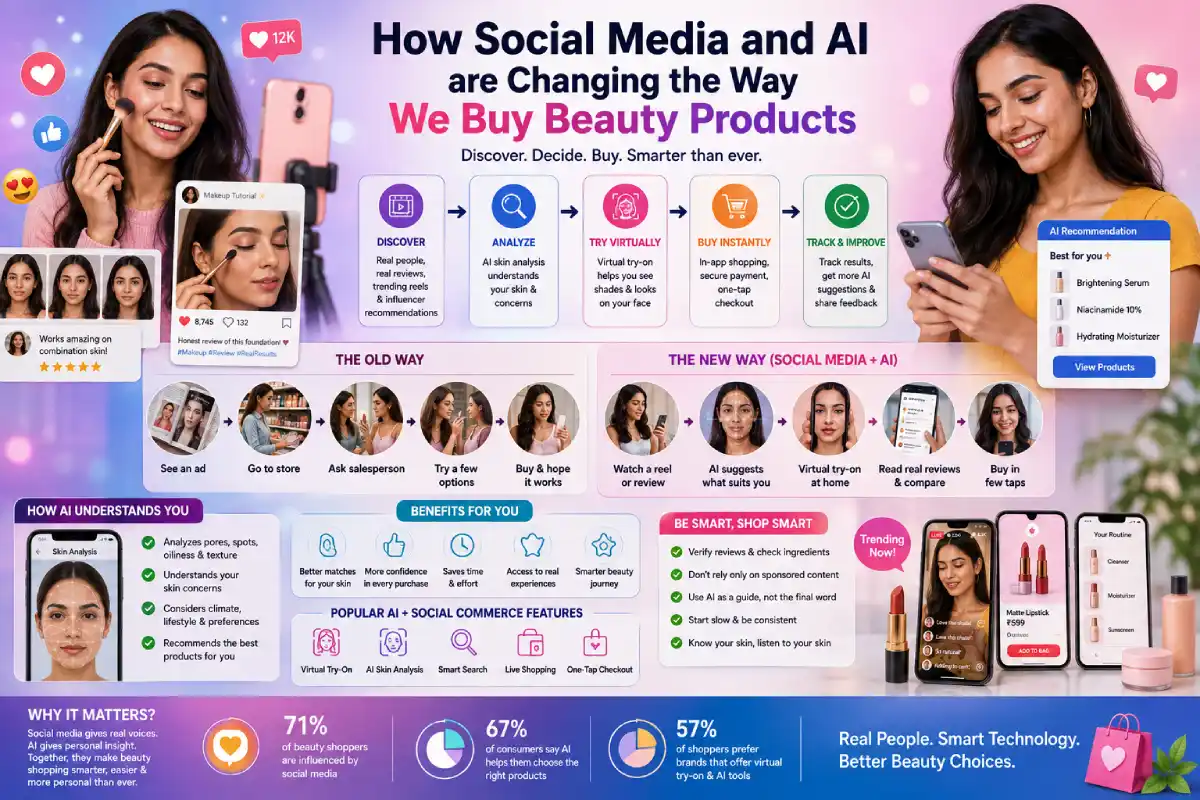
How Social Media and AI are Changing the Way We Buy Beauty Products
Buying beauty products used to follow a simple path. You saw something in a magazine or on television. You went to a store. You asked the sales person. You tried a few options. You bought what felt right.
Today the path is very different. Social media shows you products through short videos and real people. Artificial intelligence suggests what might suit your skin. You can try shades on your face without leaving home. You can buy in a few taps. The whole process of discovering, deciding, and purchasing beauty products has changed.
This article explains how social media and AI are reshaping the way people buy beauty products in 2026, especially for everyday users in India.
The Old Way vs The New Way
| Aspect | Traditional Buying | Social Media + AI Buying (2026) |
|---|---|---|
| Discovery | Ads, magazines, store displays | Reels, short videos, influencer posts, AI suggestions |
| Trust | Brand name or sales person | Real user reviews, before-after videos, comments |
| Trying products | In-store testers | Virtual try-on on phone |
| Decision making | Limited information | Ingredient details, skin analysis, comparisons |
| Purchase | Physical store or basic website | In-app buying, social commerce, one-tap checkout |
| After buying | Hope it works | Track results, share experience, get more suggestions |
How Social Media Changed Beauty Buying
Social media turned ordinary people into the main source of beauty information.
Short videos and reels
A 15–30 second video showing a real person applying a product, talking about their skin type, and showing results is more powerful than a polished advertisement for many buyers. People trust “someone like me” more than a celebrity sometimes.
Influencers and creators
From big creators to small local accounts, people share honest routines, failures, and favourites. This creates a constant stream of product discovery. A product can become popular very fast if several trusted creators talk about it.
Comments and community
Buyers now read comments before purchasing. Questions like “Does this work on oily skin in Mumbai humidity?” or “Is this good for pigmentation?” get real answers from other users. This peer advice is powerful.
Social commerce
You no longer need to leave the app. Many platforms allow you to watch a video and buy the product directly. Live shopping sessions, where creators demonstrate products in real time and answer questions, are becoming common.
User-generated content
Real photos and videos from customers now influence buying decisions as much as brand content. Brands that encourage honest sharing often build stronger trust.
How AI is Changing the Buying Process
While social media creates discovery and trust, AI makes the process more personal and efficient.
Personalised recommendations
AI looks at your past purchases, browsing history, skin concerns, and even climate data. It then suggests products more likely to suit you. Instead of showing the same bestsellers to everyone, the feed becomes more relevant.
AI skin analysis
Many apps let you scan your face. The AI assesses oiliness, pigmentation, pores, and other factors, then recommends products. This reduces pure guesswork.
Virtual try-on
AI-powered augmented reality lets you see lipstick, foundation, or eyeshadow on your actual face before buying. This is one of the biggest improvements for online beauty shopping.
Smarter search
You can now search in natural language. Instead of typing exact product names, you can say “moisturizer for dry skin in winter” or “serum for dark spots” and get useful results.
Chat and assistance
AI chat tools on beauty platforms answer questions about ingredients, routines, or product differences instantly.
The Combined Effect: Social Media + AI
The real change happens when both work together.
- You see a product in a reel (social media).
- You check virtual try-on or skin analysis (AI).
- You read real user comments (social proof).
- AI suggests similar products that match your profile.
- You buy without leaving the platform.
This combination makes buying faster, more informed, and more personal than before.
Benefits for Everyday Buyers
More information before buying
You can see real results, ingredient discussions, and multiple opinions.
Better matching for your skin
AI analysis and personalised suggestions help reduce wrong purchases, especially useful for common Indian concerns like pigmentation and combination skin.
Convenience
Discovery, research, try-on, and purchase can happen in one place.
Access for more people
People in smaller towns can see detailed reviews and try shades virtually without depending only on local stores.
Learning opportunity
Many creators explain why a product works or does not work. This increases general beauty knowledge.
Challenges and Things to Be Careful About
Too much information
The constant stream of new products and routines can create confusion or pressure to keep buying.
Sponsored content
Not every recommendation is fully honest. Some posts are paid. It is important to look for balanced opinions.
Filter and lighting effects
Social media results can look better than real life because of filters, lighting, and editing.
AI limitations
Skin analysis depends on photo quality. Product suggestions may favour certain brands. AI is not a doctor.
Impulse buying
Easy one-tap purchase and constant discovery can lead to buying things you do not really need.
How Indian Buyers Are Experiencing the Change
In India, platforms like Nykaa and social media apps have made beauty shopping more interactive. Virtual try-on helps with shade matching across diverse skin tones. AI skin tools address common local concerns. Short videos in regional languages and from local creators make information more relatable.
At the same time, traditional factors still matter — family recommendations, local store advice, and personal experience continue to influence decisions.
Practical Tips for Smarter Beauty Buying in 2026
- Use social media for discovery, but verify with multiple sources.
- Try virtual try-on before buying foundation or lipstick.
- Use AI skin analysis as a starting point, not the final word.
- Read both positive and critical reviews.
- Check ingredients for your specific concerns.
- Start with one new product at a time.
- Give any new product enough time (usually 4–6 weeks) before judging.
- Be aware of sponsored content and filters.
- Keep your basic routine strong (cleanse, moisturise, sunscreen) no matter what trends appear.
What This Means for the Future
Social media and AI will continue to shape beauty buying. We can expect:
- More accurate personalisation
- Better virtual try-on experiences
- Stronger connection between content and purchase
- More tools that combine analysis, education, and shopping
The buyers who benefit most will be those who use these tools thoughtfully — taking the useful parts and ignoring the noise.
Final Thoughts
Social media and AI have moved beauty buying from limited information and guesswork to a more open, interactive, and personal process. You can discover products through real people, check how they look on your face, get data-based suggestions, and buy with more confidence than before.
The change is powerful, but it works best when combined with common sense. Technology can show you options and reduce some risks. Your own observation, patience, and understanding of your skin still matter the most.
Use social media to learn and discover. Use AI to get clearer starting points. Then decide slowly and stick to what actually works for your skin. That balanced approach helps you get the benefits of the new way of buying without getting lost in it.
